
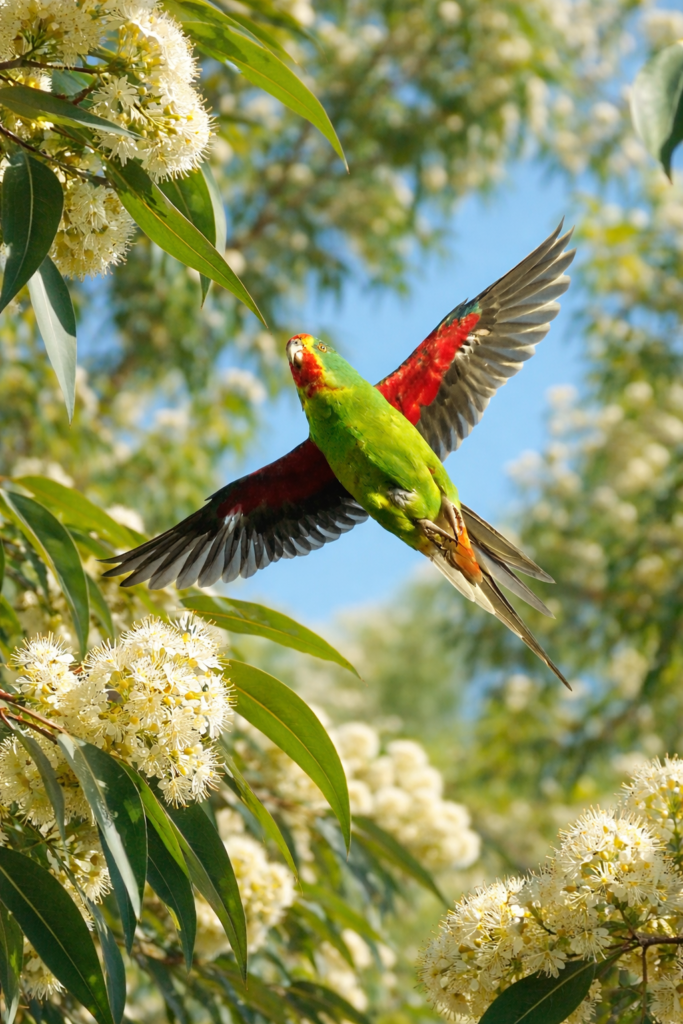
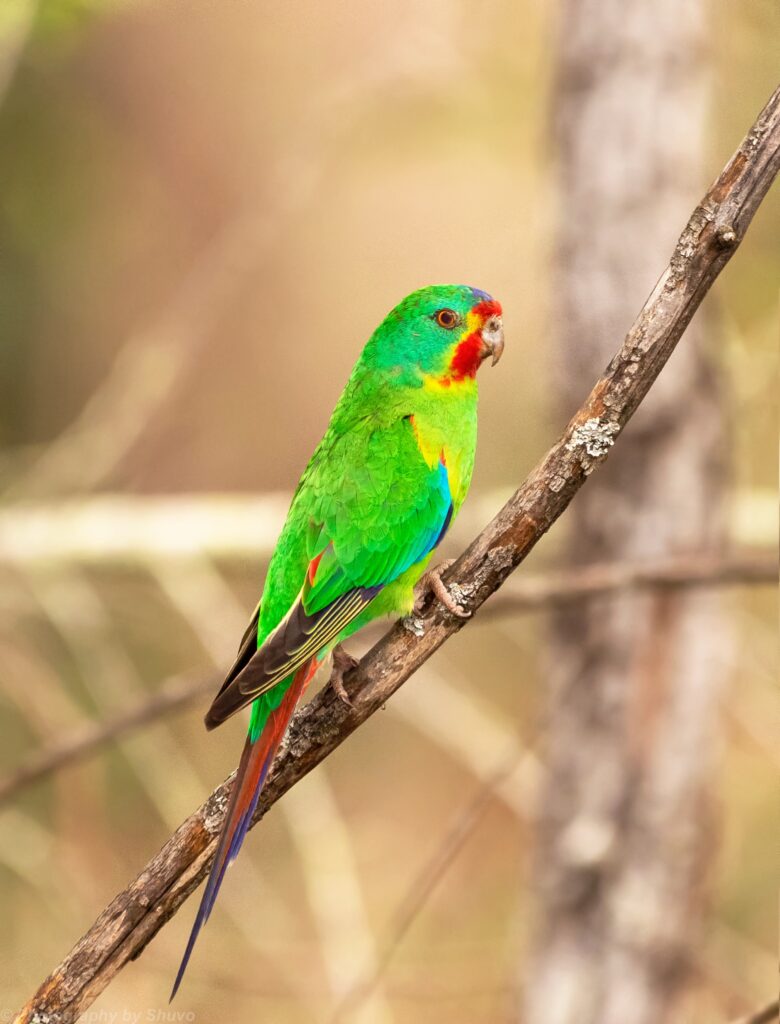
Few species in Australia have been so effectively weaponised in public debate as the swift parrot. A small, fast-flying migratory bird that once moved in flocks of hundreds across the forests of eastern Tasmania has, in recent decades, been recast as more than just a species in trouble. It has become a symbol, a banner, and, most conveniently of all, a scapegoat.
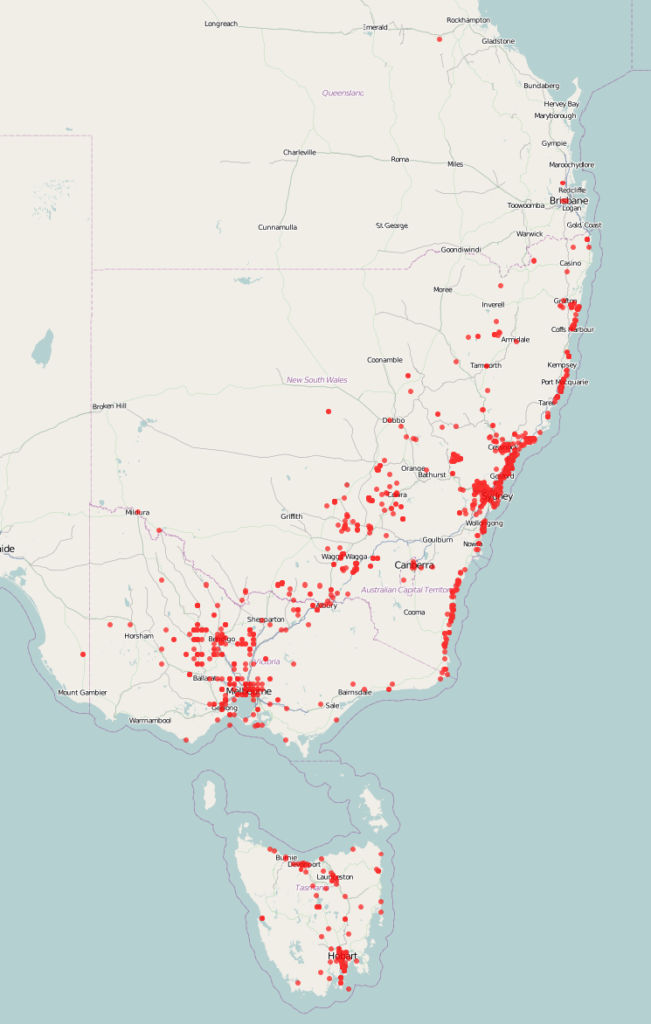
It is a species that overwinters in southeastern Australia and migrates to and from Tasmania to breed during spring and summer. Numbers have fallen dramatically over the past two decades and the species is now listed as Critically Endangered.
Much of the public commentary tells a simple, emotionally powerful story. Logging destroys the habitat upon which the swift parrot depends. Therefore, timber harvesting is driving the species towards extinction. Stop harvesting, and the bird will be saved. It’s a tidy story. However, based on the current evidence, it’s fundamentally misleading.
When one steps back from the slogans, protest imagery and the increasingly aggressive claims that have come to dominate public discourse, a very different picture emerges. It is less politically convenient, much more confronting, and, importantly, much more aligned with empirical science.
A species turned into a symbol
The modern campaign for the swift parrot is built around a simple, emotionally compelling story. The bird’s biology makes it perfect for advocacy. It is a charismatic, critically endangered species linked to forests that are themselves socially contested. It migrates unpredictably, turning up in different spots each year, often through sheer ecological coincidence, in areas scheduled for harvesting. It depends on large, hollow-bearing trees that take centuries to grow. And it is visually striking enough to capture public interest.
In this context, it’s no surprise that the swift parrot has become an “emblem species” — a poster child, representing broader debates about forestry, conservation and land use. Campaigns to “save the swift parrot” are rarely only about the bird. Instead, they seek to halt native forest timber harvesting, reshape land management policies and promote a particular philosophical stance on how forests should be managed.
The bird features on protest placards, lends its name to sanctuaries and campaigns and is invoked as a moral argument against forestry operations. The implication is that if the bird disappears, the blame rests firmly with those who continue to harvest timber.
Yet this narrative rests on an assumption that warrants far more scrutiny than it usually receives — that habitat loss from modern forestry is the primary cause of the species’ decline.
What the scientific studies actually say
The recent paper by independent researcher Simon Grove offers perhaps the clearest and most thorough re-examination of the evidence so far. It does not dismiss habitat loss as a potential factor, nor does it claim that historical clearing has not had significant impacts. But it does something that has been noticeably absent from much of the public debate. It tests competing hypotheses against the available data.
On one side is the “forest habitat narrative,” which argues that the ongoing loss or degradation of breeding habitat, especially through timber harvesting, is causing the decline. On the other side is the “predation narrative,” which claims that the main driver is predation by the sugar glider, an introduced species.
The difference is more than just academic, and it lies at the core of any conservation strategy. If habitat loss is the main problem, then protecting forests, especially by stopping harvesting, is the most important strategy. If predation is the key concern, conservation efforts must focus on reducing the threat, regardless of what happens in the forest estate.
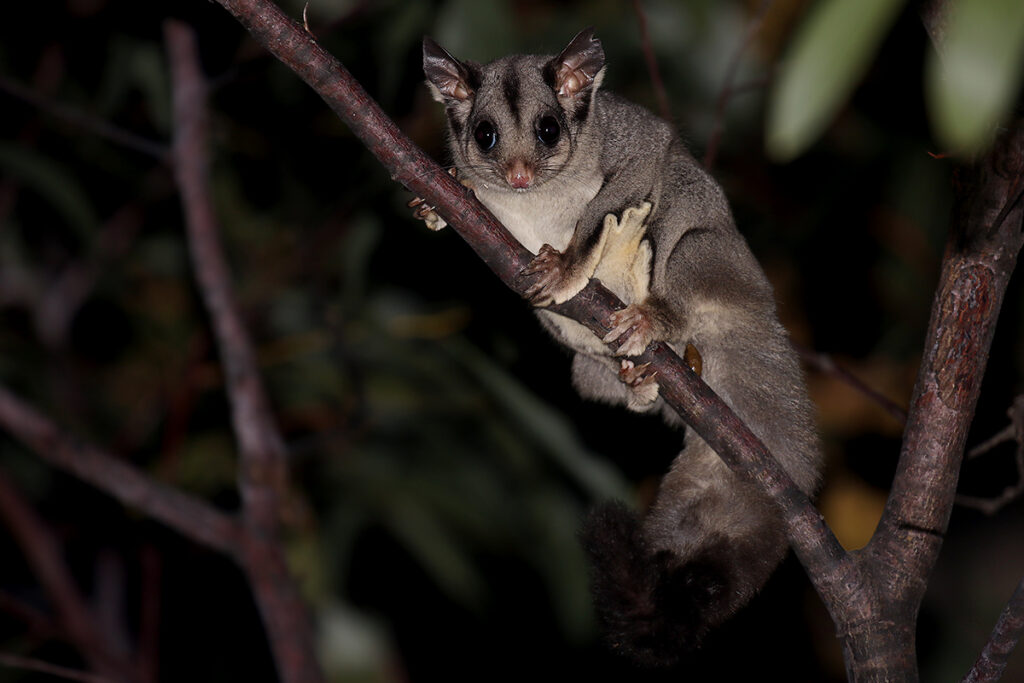
Grove’s conclusion is clear. The evidence does not strongly support the habitat hypothesis, either in its simple form or in the more nuanced version that links harvesting to increased predation risk. Meanwhile, the predation hypothesis is based on empirical observations and supported by robust and repeatable modelling.
The figures are stark. Predation rates on nesting females can exceed 40-60 per cent, and nest failure rates often range from 50 to nearly 80 per cent. In some areas, predation can reach catastrophic levels, causing all nests to fail. The consequences cascade through the population, including reduced recruitment, loss of breeding females, skewed sex ratios and a rapid decline towards functional extinction.
Perhaps the most revealing insight comes from population modelling. In the absence of predation, the swift parrot population is projected to rapidly grow, not decline. That single finding challenges much of the current narrative. It indicates that, at current population levels, the species is not fundamentally limited by habitat availability, or lack thereof. Instead, it is being held back by an external mortality factor.
The uncomfortable implications
If predation is the main factor, then the conservation implications are significant and challenging.
This means that protecting more habitats from logging alone will have little effect on halting the decline. As Grove notes, a strategy solely focused on habitat protection would “make negligible material difference” in the short term, which is the only time horizon relevant for the swift parrots, given how close they are to extinction. All it would achieve is to ensure that the remaining birds continue to nest in areas where they are highly likely to be preyed upon.
It also means that the primary claim of many advocacy campaigns that timber harvesting is the biggest threat is not supported by the evidence. This inconvenient truth makes it difficult to craft persuasive protest messages, and it doesn’t lend itself to straightforward slogans. Essentially, it doesn’t align with broader ideological views about forestry.
So, it’s probably not surprising that this conclusion has had trouble gaining ground in public discourse.
It’s not as if predation by introduced animals is a novel cause of endangerment for Australian animals. A recent study by John van Osta and colleagues shows that the southern squatter pigeon has had about a 48 per cent decline in its distribution since pre-European times, with fox density emerging as the dominant driver of the species’ current distribution, outweighing habitat condition and other threats.
Other ecologists working in Central Queensland believe the same pattern exists for the bush stone-curlew, Australian bustard, rufous bettong and spectacled hare-wallaby, among many others. The effects of fox predation have been largely ignored or forgotten because they are too difficult to address, much like the sugar glider.
The swift parrot is far from the only Australian species facing a conservation dilemma where predation, rather than habitat alone, emerges as the critical limiting factor. Recent research from the University of Sydney into the critically endangered regent honeyeater illustrates the same uncomfortable reality. Researchers found that incidental egg predation by native common brushtail possums may place additional pressure on an already tiny and declining population.
The study highlighted an important ecological principle that is often lost in simplistic public debates. Predation is a natural interaction within ecosystems, but once populations become sufficiently reduced, even relatively modest levels of predation can have disproportionate effects on recruitment and long-term viability. In other words, once a species enters a critically endangered state, pressures that were once ecologically tolerable can suddenly become decisive.
Importantly, the researchers did not frame the issue as a morality play about “good” and “bad” forests. Nor did they simply default to blaming habitat loss for every observed decline. Instead, they focused on understanding the biological processes that shape the species’ trajectory.
That same principle applies to the swift parrot. Whether sugar gliders are native or introduced to Tasmania is ultimately secondary to the observable reality that they are killing nesting females and destroying breeding success at rates high enough to drive population collapse. Ignoring that evidence because it complicates an ideological narrative about forestry does nothing to help the species.
The persistence of the logging narrative
Despite increasing and unequivocal evidence of the threat posed by predation, the idea that timber harvesting is responsible remains surprisingly resilient.
Part of this can be attributed to the argument’s intuitive appeal. The swift parrot depends on old trees with hollows. Logging removes trees, so logging must be the problem. It’s a line of reasoning that feels right, even if it doesn’t stand up to closer scrutiny.
Another crucial factor is the historical context. There’s no doubt that large areas of suitable habitat were cleared following European settlement. That legacy still shapes the landscape today. However, the conflation of historical deforestation with current, highly regulated forestry practices is rarely examined critically.
Grove’s review highlights an important point that is often overlooked. Although some studies suggest impacts of forest harvesting on habitat, they do not demonstrate that current habitat availability is declining at a rate even close to what would be required to explain the observed population collapse. In most cases, even the existence of these frameworks isn’t acknowledged. Nor do they adequately account for the regulatory frameworks governing forestry operations, including habitat retention measures and exclusions from known breeding areas.

Sustainable Timber Tasmania’s monitoring programs, for example, actively identify potential breeding sites, exclude nesting trees, conserve foraging habitat and adjust operations based on observed bird activity. Surveys have documented birds foraging and breeding in both production forests and retained habitats within harvested coupes.
This isn’t a picture of reckless habitat destruction. It’s of well-managed landscapes, where conservation efforts are integrated into forestry activities.
A species in reserves and still declining
There is a deeper irony here, one that echoes themes I have explored in earlier blogs.
If the prevailing story were correct, we would expect species to thrive in areas where logging has ceased. However, as I have pointed out in previous blogs here, here, here and here, there is ample evidence that reserving land and leaving it to benign neglect does not ensure species recovery.
The swift parrot clearly demonstrates this. Much of its probable breeding habitat is already protected either in formal reserves or through management agreements or interventions. Nonetheless, the population keeps declining.
Why? Because the primary threat, predation by sugar gliders, ignores reserve boundaries. The gliders are common across mainland Tasmania. They inhabit both managed forests and reserves. And whenever swift parrots try to nest in these areas, they face high predation levels.
In contrast, the only areas where breeding success remains reliably high are offshore islands, specifically Bruny and Maria, where sugar gliders do not exist. In these safe havens, nest survival can reach 90 to 100 per cent. The difference isn’t in habitat; it’s in predation.
The weak link between logging and predation
One of the more nuanced versions of the habitat argument suggests that harvesting could indirectly increase predation by altering forest structure, thereby making nests more exposed. This is a compelling idea because it lets advocates recognise the role of predation while still placing the ultimate responsibility on forestry practices.
But once again, the evidence remains far from convincing. The link between forest condition and predation risk is weak, inconsistent, contradictory and often unclear due to methodological uncertainties. There is little consistency in the relationship between forest condition and predation risk or outcomes. Indeed, predation rates can sometimes be as high or higher in forests reserved from harvesting as in those managed for timber.
More importantly, even in the most untouched forest areas, predation rates remain high enough to cause sharp population declines. Whether harvesting occurs or not doesn’t fundamentally alter this fact.
The real conservation challenge
If we accept that predation is the primary, overriding driver, then the conservation challenge becomes considerably more difficult.
Unlike habitat protection, which can be achieved through policy and land-use regulations, reducing predation on a large scale remains a complex and unresolved challenge. Trials involving nest boxes, predator deterrents and localised culling have shown limited results. The logistics of safeguarding nests across a vast and fluctuating landscape are formidable.
This is the hard truth at the heart of the swift parrot story. The species isn’t declining because we lack the political will to stop timber harvesting. It is declining because we haven’t yet found a successful way to control a widespread and highly effective predator.
That is not a message that lends itself to simple solutions or clear lines of advocacy. It does not present an obvious villain to manipulate or an easy policy lever. And so, perhaps inevitably, it has been overshadowed by a more convenient narrative.
The danger of getting it wrong
The consequences of misdiagnosing the issue are serious.
If conservation efforts focus on the wrong threat, they will fail, no matter how well-meaning. Worse, they might divert attention and resources from actions more likely to make a real difference.
In the case of the swift parrot, an exclusive focus on habitat protection risks doing more harm than good. It creates the illusion of progress while leaving the main cause of decline unaddressed. It allows policies to be portrayed as conservation successes, even as the species continues its course towards extinction.
This isn’t unique to the swift parrot. It highlights a broader pattern in conservation, in which complex ecological issues are simplified into stories that align with existing ideological views. Timber harvesting, grazing and mining are tangible, visible activities that can be opposed and regulated. Predation by an introduced species is less visible, less politically convenient and much more challenging to manage.
Beyond ideology: returning to evidence
None of this suggests that forestry should be immune from scrutiny, nor that habitat factors are unimportant. Forest management must continue to evolve, guided by the best scientific evidence and a genuine commitment to biodiversity conservation. However, it does mean that any conservation policy must rely on evidence rather than assumptions.
The swift parrot illustrates a simple yet often overlooked idea that successful conservation depends on accurately identifying the primary causes of decline. If we get that wrong, everything that follows is on unstable ground.
Grove’s paper provides a handy reminder about this. Examining the evidence and testing different hypotheses helps remove much of the clutter around the issue. It doesn’t offer simple answers, but it does bring clarity.
And that clarity leads to a conclusion that is both inconvenient and unavoidable for the activists and academics who call for a cessation of timber harvesting. The decline of the swift parrot isn’t mainly caused by modern forestry practices. The evidence clearly shows that predation is the primary factor.
A final reflection
The feature image of a swift parrot darting through the canopy of a flowering blue gum, its green plumage flashing in the light, is powerful. It speaks to something deeper than data and models. It reminds us of the richness and complexity of the natural world.
But if we truly want future generations to experience that image, we must also take the threat to it seriously.
Blaming forestry might be simple. It can align with larger agendas and resonate with urban public sentiment. However, a straightforward story is not a substitute for truth. In conservation, as in any field involving complex systems and tough decisions, truth is essential. If we continue to focus on the wrong cause of the decline, we will keep failing the swift parrot we claim to protect.
And the swift parrot won’t be saved by stories designed to sway easily influenced crowds. It can only be saved by scientific evidence.
Thank you for your reports, Robert.
I was sent a link via Facebook to your report on wind farms and their effects on forests and pristine terrain throughout Qld. I was horrified and wanted to send the link to friends. I have been unable to access that link, and I was hoping you could provide it to me.
Thank you for your work. John Jerrard
About 15 years ago, a very successful Australian threatened-species conservationist, while addressing a catchment management committee, commented:
“A species population may be in decline. As soon as research focuses on that species, you can expect a dramatic decline in its claimed population. This appears to be related to funding. The closer a species gets to extinction, the easier it gets to raise the necessary funding for research into that species”.
It does not help your funding prospects to proclaim that, based on your research, the species is recovering!
Thanks, Robert, for your excellent objective sitrep on the swift parrot, an enigmatic, erratic and unpredictable follower of the eucalypt honey flow across the east coast.
The last ones I saw were at Batemans Bay during the heavy flowering of spotted gum in April-May 2008.
Despite regular flowering since then (and another heavy one budding up now), nary a swift parrot among the strong lorikeet population here. Previously, only seen at Beerwah in Qld in the mid 60s feeding on blackbutt. One wonders why breeding is restricted to Tasmania when there are obvious suitable breeding sites in the southeastern coastal eucalypt forests.
But then birds have weird habits that may be leftovers from past ecological conditions, e.g., why do koels and channel-billed cuckoos fly all the way from FNQ/PNG to parasitise nesting red wattle birds and satin birds on the south coast, then fly back home with the newly fledged young?
The problem with recognising the glider predation issue in Tasmania may, in part, be that gliders are gorgeous, fluffy animals native to the mainland. Undoubtedly, some of the Leadbeater possum embroglio in Victoria has transferred to this little furry feral across the water.
I wonder what Kiwis would think about this one, given the problems they have in NZ with introduced brush-tailed possums?
Exactly past ecological conditions is why the swift breeds in Tasmania. The absence of the sugar glider greatly benefited the breeding and ultimate survival of the subject to maturity and the development of its own instincts to repeat the cycle of succession.