While visiting the Victoria River region in northern Australia, it felt like stepping back in time. The land seemed as wild and untamed as when Augustus Charles Gregory and his men arrived 170 years ago. I set off toward their historic base camp, eager to be a part of where history unfolded. Standing beneath the gnarled limbs of the ancient and famous boab tree, I felt the weight of history pressing down on me. The tree, scarred with marks of the past, has stood as a silent sentinel over the Victoria River for many years, witnessing exploration, hardship, and endurance. Its swollen trunk preserves the story of one of Australia’s most remarkable expeditions.
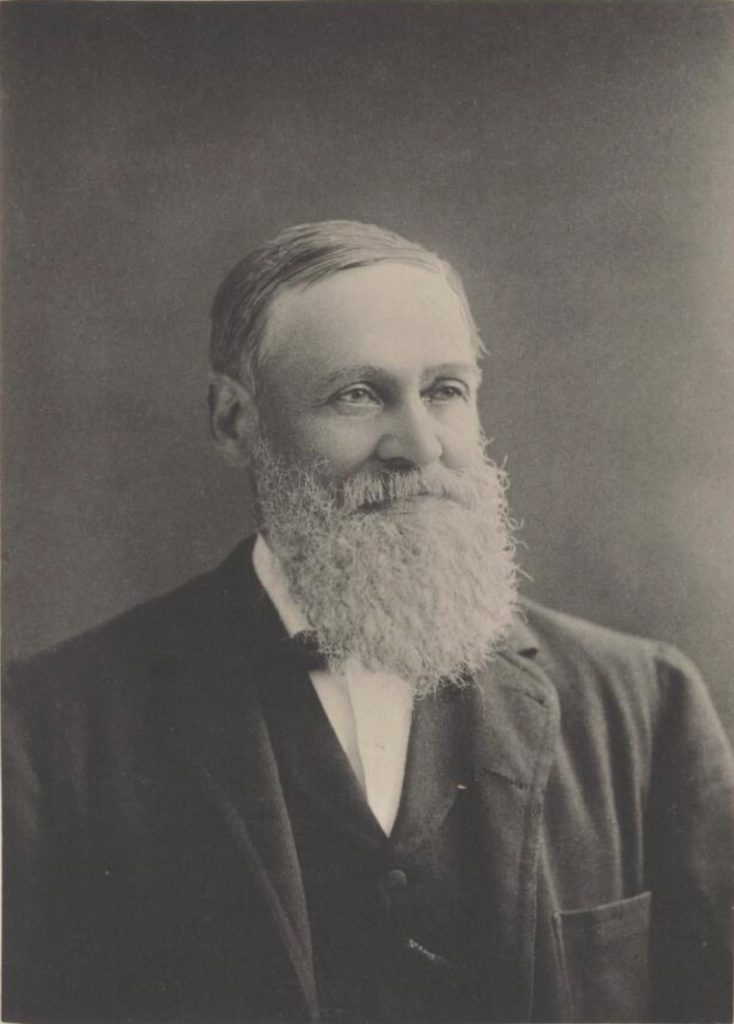
Augustus Charles Gregory 1890. National Library of Australia digitised item. PIC Album 277a #PIC/16301/2
Gregory led an ambitious journey into the vast and uncharted northern Australia, an awe-inspiring and unforgiving land. The British government commissioned the North Australian Expedition to map the interior, assess its agricultural potential, and find an inland route to the Gulf of Carpentaria. Specifically, Gregory was tasked with evaluating reports of the Top End’s “plains of promise” for colonial settlement.
Gregory meticulously planned the expedition. Unlike the ill-fated Burke and Wills expedition years later, he and his team adapted to the challenges, relying on careful preparation and a measured pace. They navigated vast, waterless stretches without faltering. Gregory’s ability to maintain discipline and morale set him apart from many other explorers of the era. He carefully rationed the expedition’s supplies, including dried provisions, equipment for mapping and navigation, and livestock for sustenance.
The party arrived in the Victoria River region and established a base camp near a water source on the west bank of the Victoria River. This was a crucial element of his strategy to ensure proper rest, refresh the horses and supplies, organise their surveys and collections, and plan the next leg of their journey. The explorers could travel light and swiftly by leaving most of their supplies at the base camp and loading pack horses with only the essentials.
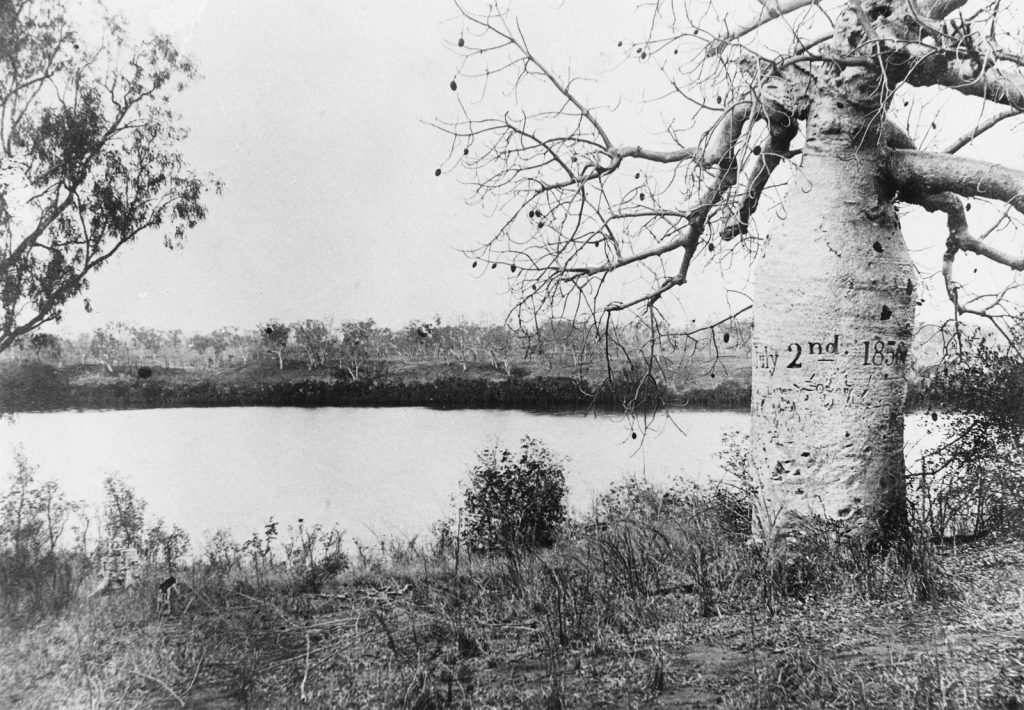
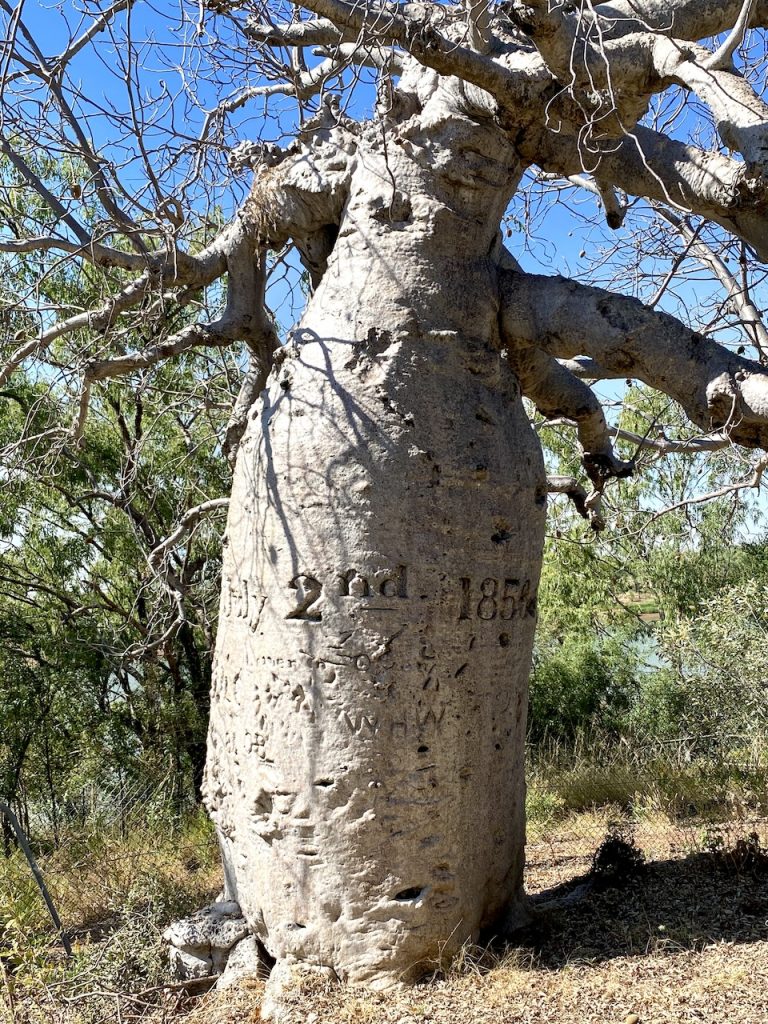
Thomas Baines, the expedition artist, carved their initials into the bark of a massive boab tree along with the arrival and departure dates of the expedition party. It remains a crude yet lasting record of their passage.
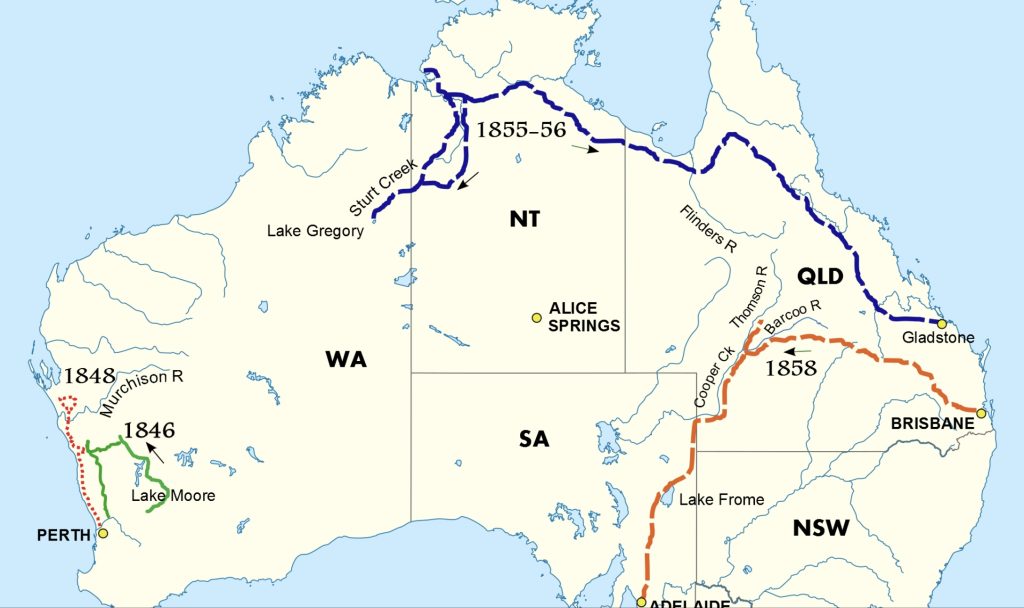
Map showing the various exploration routes of Augustus Gregory, including the Northern Expedition in 1855-56. Adapted from Australian Geographic map 1995. CC BY-SA 3.0
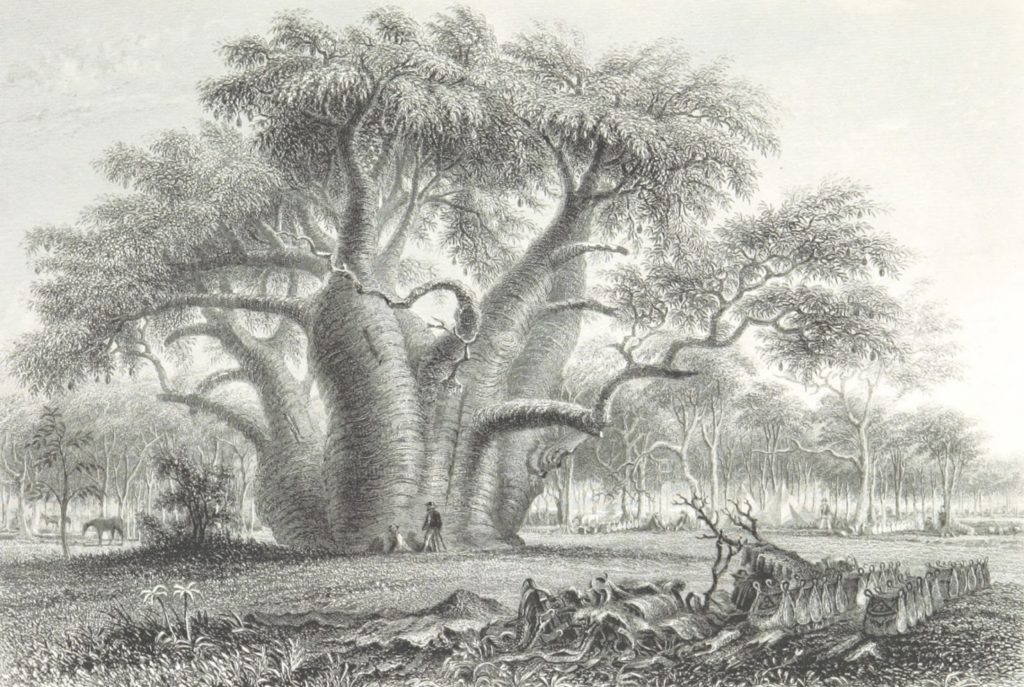
Gregory’s Tree on the bank of the Victoria River near Timber Creek (n.d.) SLQ
The expedition of 18 men departed Moreton Bay in August 1855 aboard the barque Monarch and the 112-tonne schooner Tom Tough. They reached Point Pearce at the mouth of the Victoria River on 24 September. The two boats separated there, with the Monarch continuing her journey to Singapore. The Tom Tough sailed 145 kilometres up the Victoria River to unload supplies at the base camp. Along the way, the ship’s steel keel snapped, and the influx of water destroyed some cargo. Makeshift repairs used timber cut from tall paperbarks found in a nearby creek, which Gregory named Timber Creek.
They took fifty horses to transport supplies and ride during the expedition surveys. However, seven drowned, one was “irrecoverably fixed in the mud,” and another died of exhaustion when, wild-eyed, they were forced to swim across three miles of fast-running water to reach land at Point Pearce for an overland journey to the camp.
While the exploration party encountered many challenges on their journey into the Victoria River, the site selected for the base camp, located near the ford on the river, turned out to be an excellent choice. It was sheltered by box and eucalypt trees and shaded by the occasional wattle. Two splendid boab trees stood in the centre, and the campfire was set up beneath one of them.
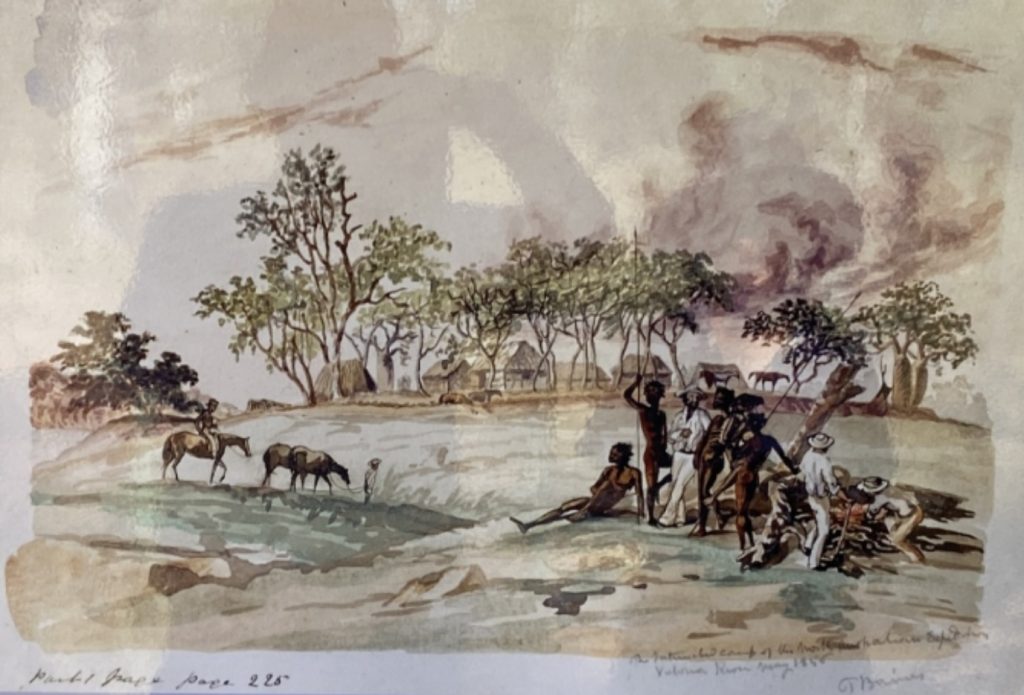
The camp’s setup was quite elaborate. Small homes were constructed from local timber and other bush materials. Sheets of paperbark served as walls, while leafy branches and grass formed thatched roofs. Beds were created from sacking stretched over a frame of branches, with a mosquito net strung overhead. Barrels and crates made convenient seats and tables.
Baines painting of the main camp in 1856.
A smaller boab that grew next to Gregory’s tree was felled. The stump became a fine table, and the hollowed trunk was repurposed as a drinking trough for the horses. A store shed was built from the salvaged timber of redundant horse drays. Unfortunately, the draught horses that were supposed to pull the carts drowned after being unloaded from the schooner. Even a small vegetable garden of radishes, mustard, and cress was established to provide a welcome change from the regular diet of flour, salt, pork, preserved beef, potatoes, rice, peas, sago, sugar, tea, coffee, vinegar, and lime juice. While 200 sheep were shipped on their journey to supply fresh meat, many did not survive the arduous trip.
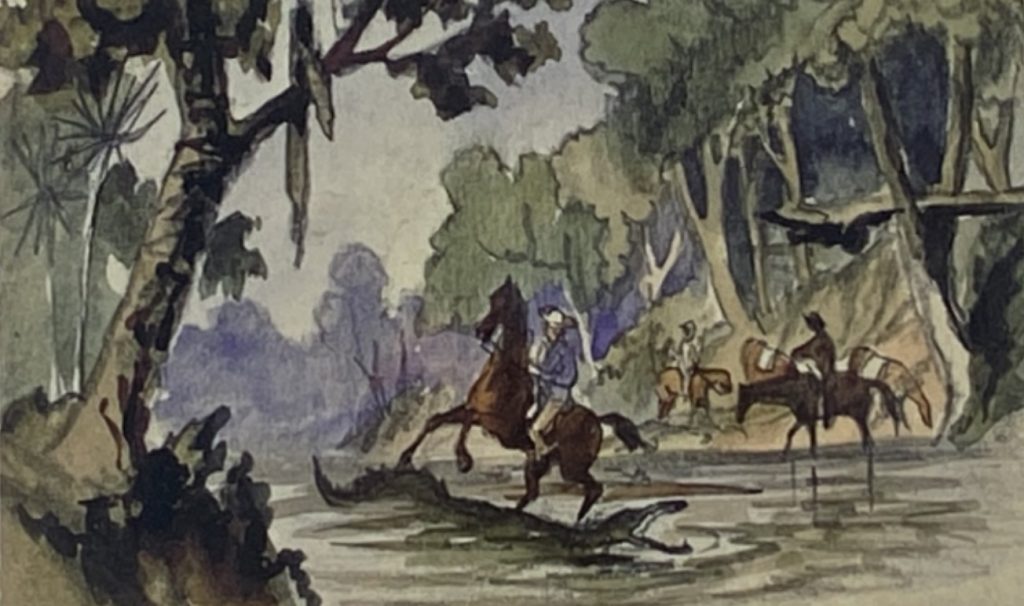
A small forge was built near the camp’s rear where twin boabs stand. It was used for repairs and for shoeing the horses. There was even a wide ditch, and later, a fence surrounded the camp, partly to defend against attacks from Aborigines but mainly to protect the camp from the threat of crocodiles.
Gregory's horse steps on crocodile, 12 April 1856. Drawing by Thomas Baines.
I tried to imagine their struggle as I stood in the Northern Territory’s dry heat. The expedition traversed harsh landscapes, battling extreme temperatures, water shortages, and the constant threat of crocodiles lurking in the nearby river. Despite these challenges, Gregory’s leadership and meticulous planning ensured his men survived. It is truly an extraordinary achievement in an era when many explorers perished in the outback’s grasp.
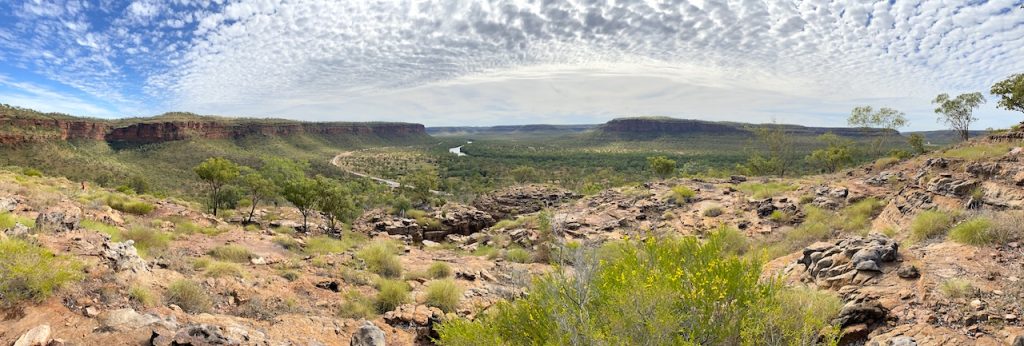
As I explored the surrounding rugged terrain, which includes spectacular sandstone escarpments, gorges, mesas, limestone karst formations, rolling hills, and alluvial plains that form part of the Victoria River catchment, I couldn’t help but ponder what a paradise it must have been for the original inhabitants.
Baines drawing of a boab tree. Titled "Gouty stem tree, near a creek south-east of Stokes Range, Victoria River". It was sketched in January 1856.
The boab – nature’s water tank
Ferdinand von Mueller was the expedition botanist. The German was described as:
drunk with the love of his science and careless of ease and regardless of difficulty in whatever form it might present itself.
The distinctive and iconic boab is only found in Western Australia’s Kimberley region and the Northern Territory’s Victoria River district. It is named after Gregory by von Mueller (Adansonia gregorii). On the expedition, he collected nearly 2,000 species of plants, 800 of which were new to Australian botany. He was not only one of the first scientists to explore the northern part of Australia but also the first to document parts of the Victorian Alps. He was undoubtedly Australia’s leading scientist of the nineteenth century and a national authority on botany, even before the federation.
But the boab tree has witnessed more than just European exploration. Long before Gregory’s arrival, the indigenous people of the region lived off the land for millennia, their understanding of its seasons, water sources, and flora sustaining them where many outsiders failed. Gregory’s campsite was also significant for the Aborigines, serving as a gathering spot for local groups to meet and hold ceremonies. For them, the boab is more than a mere marker; it is a provider. Its swollen trunk stores water, its leaves offer medicine, and its seeds serve as a food source. Gregory’s boab is not a relic of a single expedition but a thread in the larger tapestry of this land’s history.
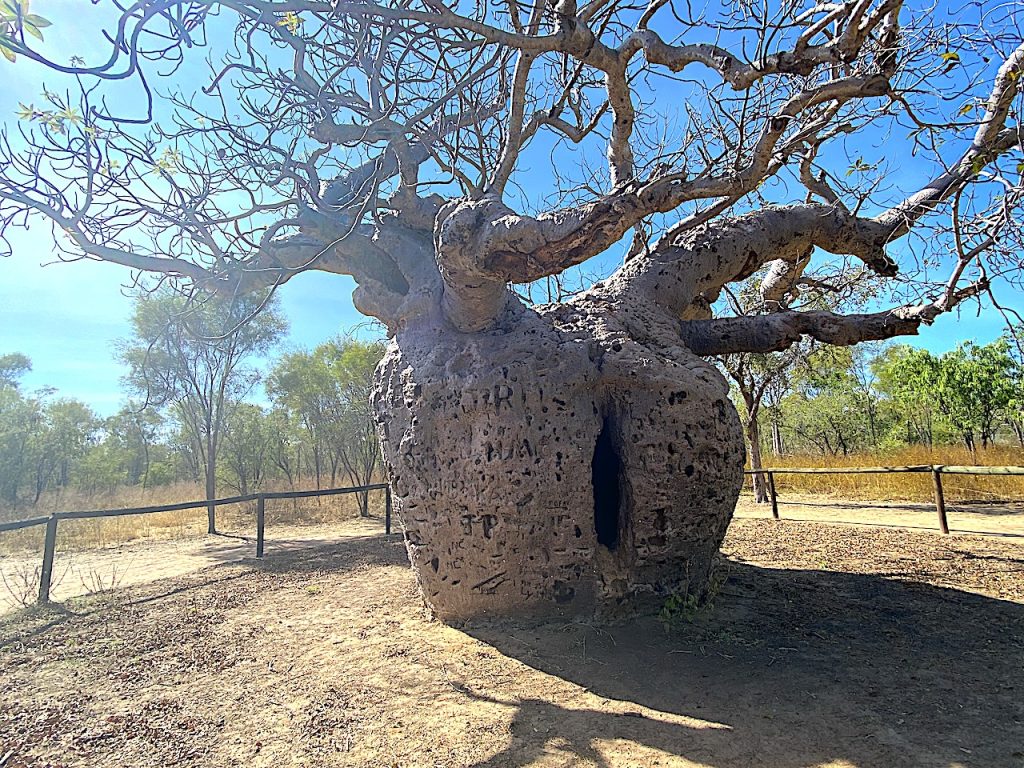
The boab tree is a testament to survival. Its immense, swollen trunk can reach over 20 metres in circumference. This unique, swollen, bottle-like trunk is filled with soft, fibrous wood, which allows it to store water, a vital resource during the dry season. The famous prison tree near Derby in Western Australia is so large that its hollow trunk was used to house prisoners.
The prison tree near Derby, Northern Territory.
Giant boab tree at Wyndham, Northern Territory. While it is difficult to determine the age of boabs, this one is estimated to be at least 2,000 years old.
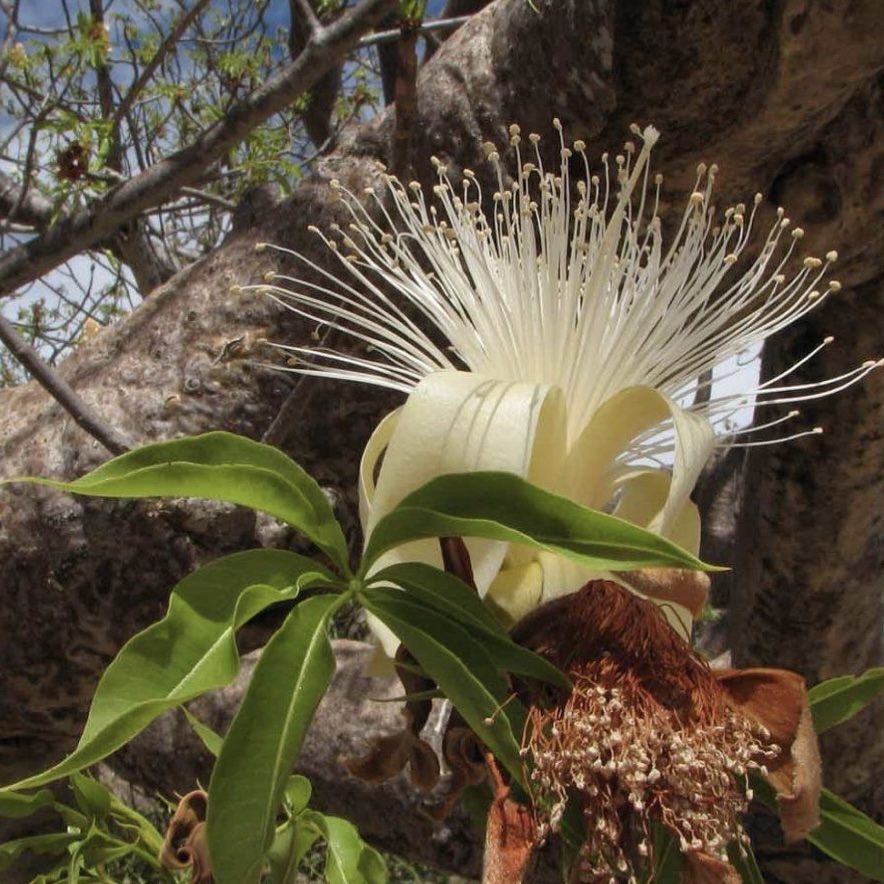
The large cream flower of the boab. They open early in the evening and are pollinated that night. Each flower lasts for only a day or two before falling.
The boab is stark and leafless for much of the dry season but is festooned with brilliant green leaves during the wet season. At this time, it also bears large white, showy flowers that have no perfume unless they are bruised, at which point they soon ferment, emitting a scent reminiscent of rotten meat. At the base of the branches are peculiar depressions in the trunk. Aboriginal people drink the water that collects there during the wet season. They also consume the seeds and the white, spongy pith in the furry, gourd-like fruit. Aborigines value these fruits for their edibility and medicinal uses. The bark from the roots is also beaten to produce string.
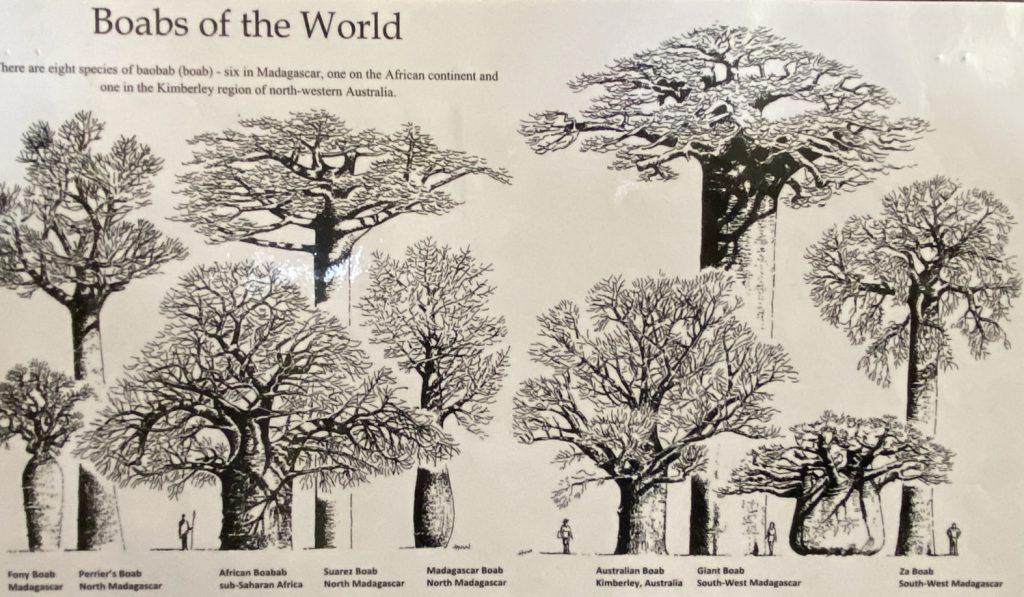
Seven other species of boab (or baobab) occur in Africa, Madagascar and the Arabian Peninsula, closely related to the only Australian species. It is unclear when or how the tree became established in Australia. Gondwanaland was connected to Africa over 100 million years ago, but the Australian boab is not that ancient.
Botanists have theorised that the Australian boab is the evolutionary result of seeds from the African species drifting across the Indian Ocean to Australia around 100 million years ago. However, many doubt that the seeds could survive the two-year journey across the ocean. A recent theory suggests that the seeds were transported by humans when they left Africa around 60 to 70,000 years ago.
Many argue that the ancient Bradshaw rock art paintings possess an African “feel” regarding technique and imagery. The presence of boabs in these paintings suggests a connection between ancient African culture and the arrival of boabs on the Australian continent.
As I stood underneath the tree’s twisted branches, I not only imagined Gregory and his party’s struggles. While they faced searing heat and freezing nights while trying to live in a foreign land, my thoughts turned to admiration for the indigenous people, who had a deep understanding of the land.
Charting the Victoria River and opening the land
When Gregory arrived in 1855, he led the first thorough land exploration of the Victoria River region, building on earlier maritime surveys. In 1839, Captain John Wickham and his lieutenant, John Stokes, had navigated the HMS Beagle into Queens Channel at the river’s mouth. During their expedition, they named the waterway in honour of Queen Victoria, describing it as:
worthy of being honoured with the name of her most gracious majesty the Queen.
Gregory undertook two expeditions from the base camp deep into the uncharted interior, pushing beyond the headwaters of the Victoria River. His exploration revealed vast tracts of prime grazing land, a resource that would later define the region. He completed the final pieces in the jigsaw map of Australia, proving there was no inland sea. However, it wasn’t just Gregory who deserved the accolades. Thomas Baines created some of the greatest colonial art of that century, and von Mueller significantly contributed to understanding Australian botany.
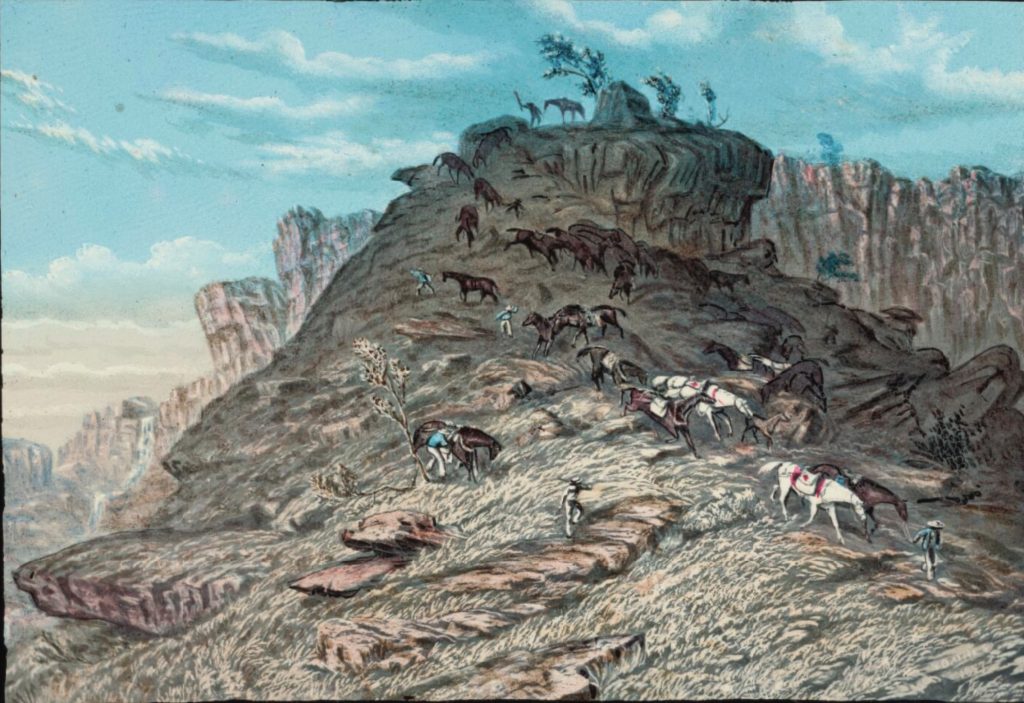
The North Australian Expedition, Augustus Charles Gregory, Commander, descending Stokes Range on the Victoria River, 1856 [transparency] / T. Baines
Over the next two decades, further expeditions confirmed the area’s potential. In 1879, Alexander Forrest traversed the region from west to east, charting new territory and naming the Negri and Humbert Rivers. His findings reinforced the growing interest in pastoral settlement.
As the region’s promise became evident, the next wave of pioneers—cattlemen and drovers—soon followed. The renowned bushman and drover Nat “Bluey” Buchanan brought the first cattle into the area, paving the way for permanent grazing enterprises. The establishment of major pastoral stations quickly followed: Victoria Downs in 1884, the Durack properties, Auvergne in 1885, and Bradshaw in 1894.
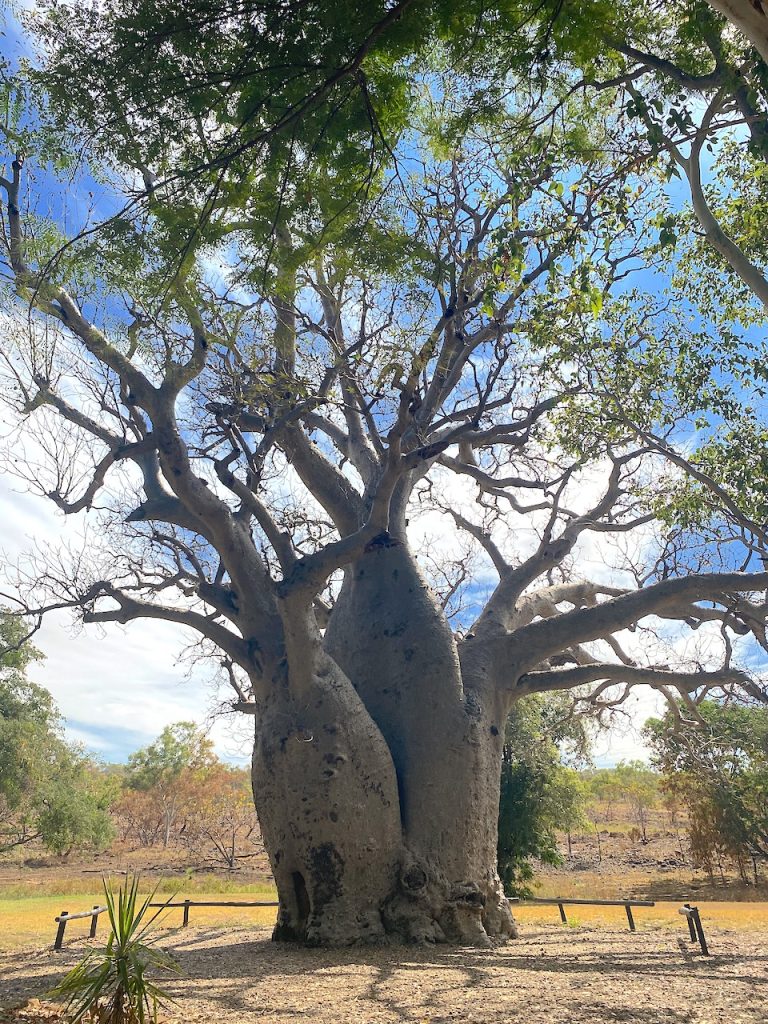
Gregory’s tree remains a place of curiosity and quiet historical reverence. Time and weather have softened the Baine’s carved marks, yet the impact of their achievement endures. Tourists and history buffs like me make the pilgrimage to see this living connection to the past, standing in the footprints of explorers while recognising the deeper heritage of those who came before them.
As I turned to leave, I cast one last glance at the boab, its gnarled limbs reaching toward the endless blue sky. More than just a tree, it served as a reminder of how the past lingers in the present, as a bridge between discovery and survival, between those who came seeking and those who already knew the land’s secrets. Gregory’s expedition is long gone, but the boab remains patient and unmoving, waiting for the next traveller to listen to its story.
Gregory's tree when I visited in July 2021.
A colleague of mine has written an excellent paper celebrating Gregory’s contributions to the nation, particularly in Queensland. His public service is extraordinary, and you can read it here.
6 thoughts on “Gregory’s boab: a sentinel of history ”
Gary John Bacon
Your writing Robert does justice to the Icon.
It took me 65 years to genuflect at the carved boab on the Victoria. His presence was palpable.
Your account of Gregory’s expedition adds another dimension to the history and discoveries of such pioneers.
Well done.
Ancestors of the Cahills, after which Cahills Crossing was named, along with Nat Buchanan, would have known the area well, and I am of the opinion that they would have been in awe of Gregory’s expedition some 30 years before them.
I know all that country, and its icons, well Robert. Your beautifully written and appropriately illustrated essay does the country, Gregory’s expedition and the icons much credit. I thank you for re-awakening in me long dormant memories of just one, magnificent story, of our wonderful and timeless land. Good health you and your good lady wife.

Your writing Robert does justice to the Icon.
It took me 65 years to genuflect at the carved boab on the Victoria. His presence was palpable.
Gary
Very interesting story about North Australian land and tree!!
Your account of Gregory’s expedition adds another dimension to the history and discoveries of such pioneers.
Well done.
Ancestors of the Cahills, after which Cahills Crossing was named, along with Nat Buchanan, would have known the area well, and I am of the opinion that they would have been in awe of Gregory’s expedition some 30 years before them.
What a wonderful history of an incredible part of Australia’s discovery.
John Harden AM.
I know all that country, and its icons, well Robert. Your beautifully written and appropriately illustrated essay does the country, Gregory’s expedition and the icons much credit. I thank you for re-awakening in me long dormant memories of just one, magnificent story, of our wonderful and timeless land. Good health you and your good lady wife.
Another very interesting, informative read Robert. I’ve only ever seen a singular trunk baob. I didn’t know that some have several trunks.