
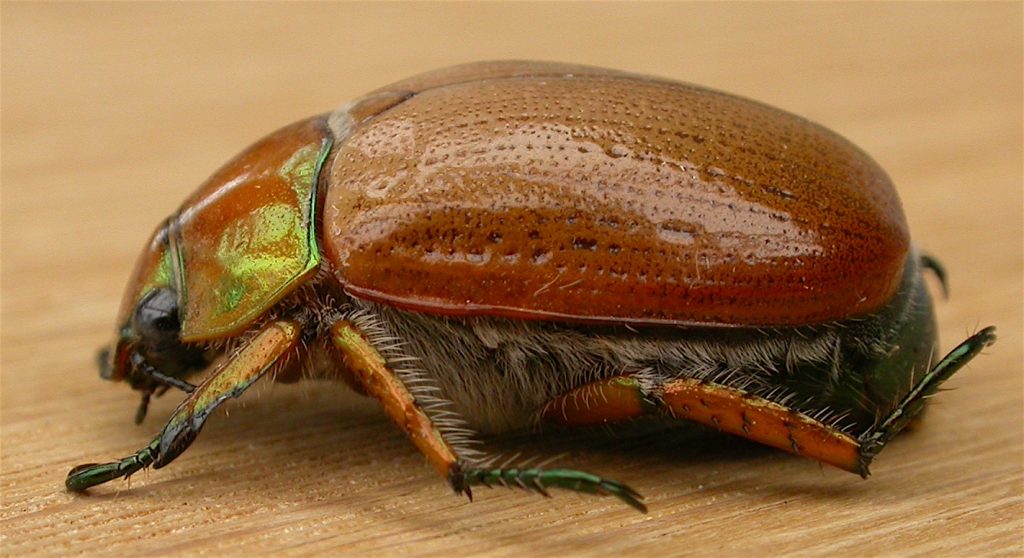
For many Australians of a certain age, the magic of Christmas wasn’t just about the excitement of presents under the tree or the smell of a roast wafting through the kitchen. It also meant the annual arrival of Christmas beetles.
Their abundance meant they quickly became ingrained in our cultural psyche. Reportedly, in the 1920s, tree branches in Sydney were weighed down by vast masses of the beetles. According to the Australian Museum website:
In the 1920s, they were reported to drown in huge numbers in Sydney Harbour, with tree branches bending into the water under the sheer weight of the massed beetles.
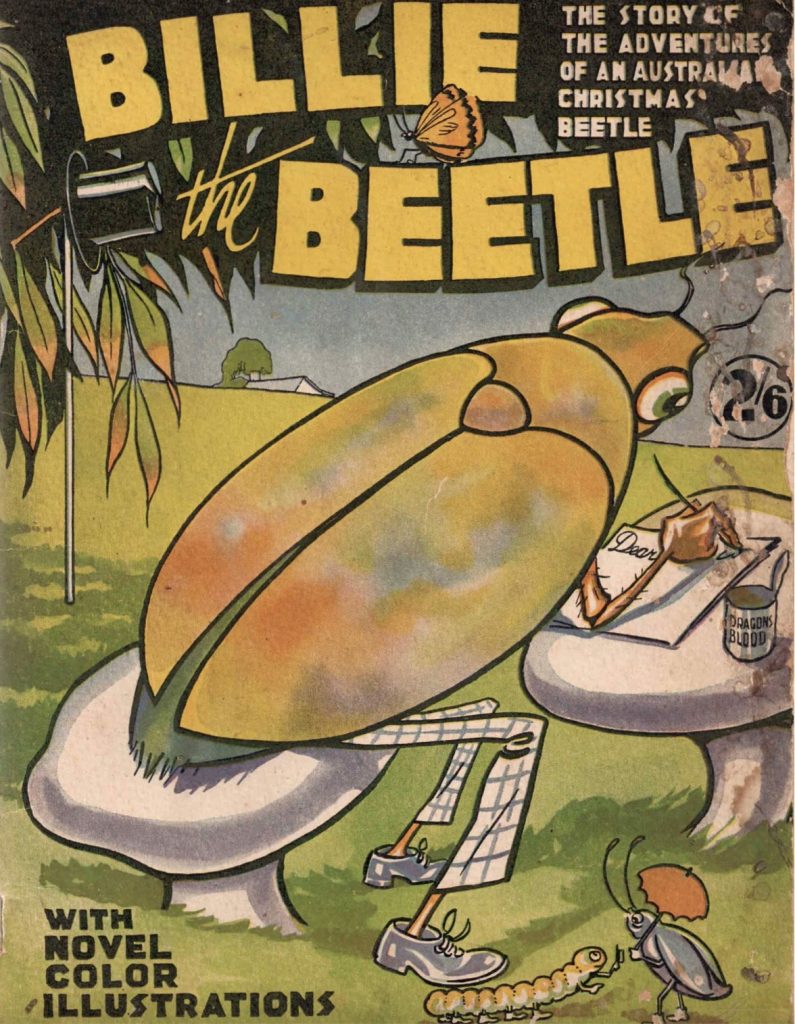
The foreword of Fred Powis’s 1946 children’s book Billie the Beetle states that:
During the summer season, the Australian Christmas beetle is a well-known little fellow to children in both town and country.
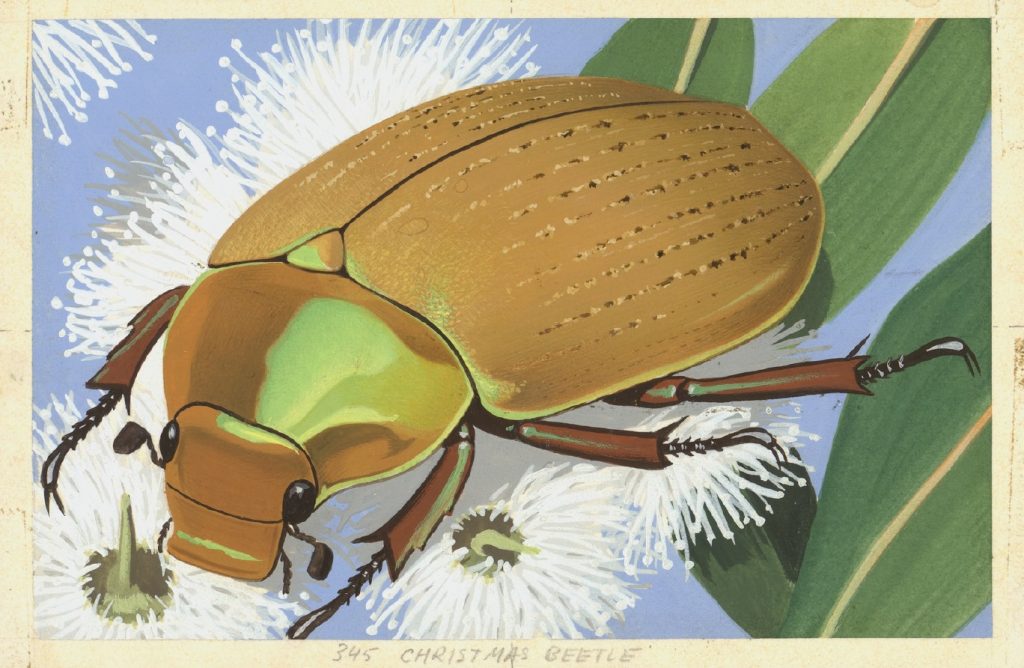
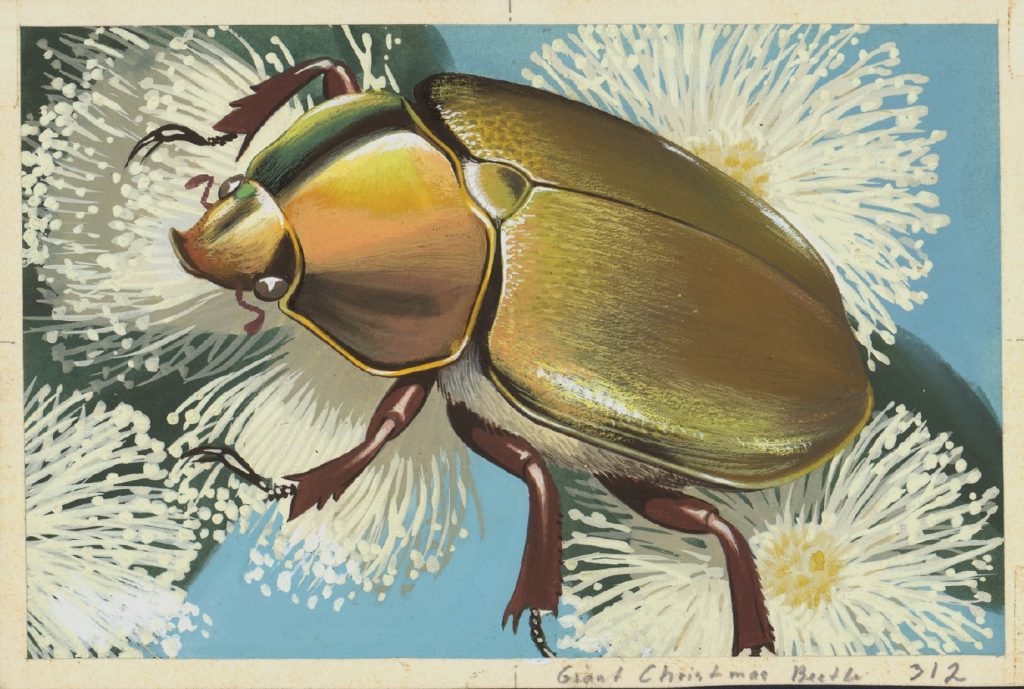
Growing up in Sydney in the 1970s, the long summer evenings felt full of them. As kids, we’d sit out the back under the bare globe of the veranda light, and soon you’d hear the faint whirr of wings followed by a clumsy thud as a beetle cannoned into the fibro wall or clattered against the flyscreen door. Sometimes they’d land in your hair or your lap, making you jump before you saw the unmistakable iridescent shell of green and gold, like something from a jeweller’s window, or bronzed and burnished, like a coin from ancient Rome.
There were nights when the back lawn seemed alive with them, their shells gleaming under the light, while the family dog snapped at them mid-flight. As kids, we loved them for their colours and their comical flying style. At Christmas parties, we would collect them in ice-cream containers with holes punched in the lid, then release them all at once, laughing as they took off in their noisy, clumsy way. The beetles were such a familiar part of our summer that you barely paid them any mind. Like cicadas screeching in the trees, they were just there.
Fast-forward to today, and many of us can’t remember the last time we saw a Christmas beetle. The backyard lights still glow in December, but the night air feels oddly empty. Sometimes I wonder if it’s because I no longer call Sydney home, but the more I think about it, the clearer it becomes that they aren’t around like they used to be.
The Beetles of Christmas Past
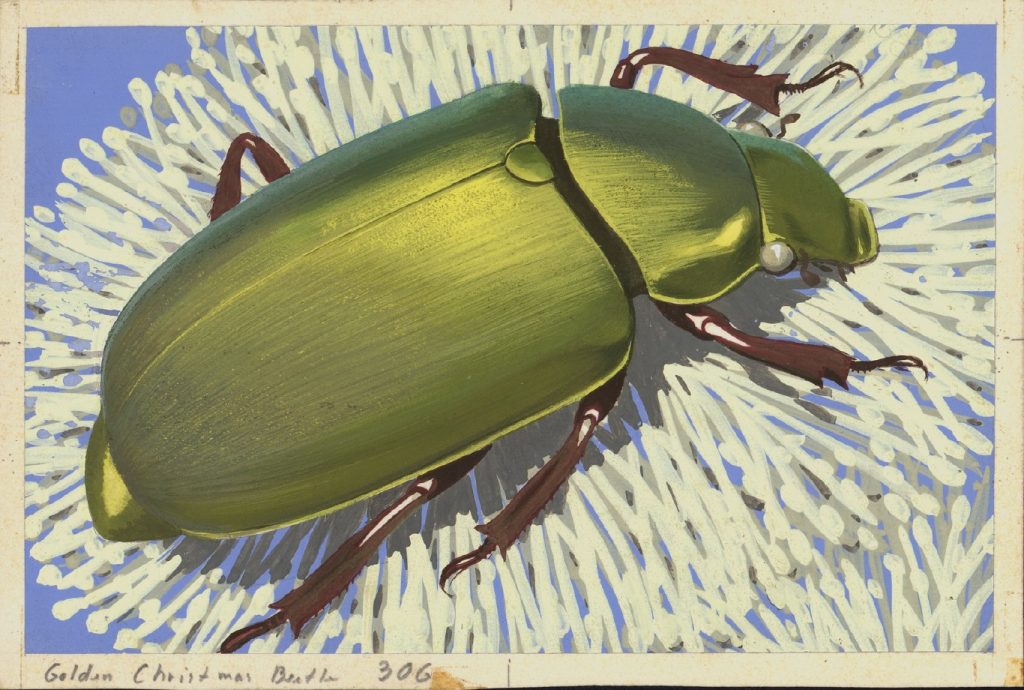
Christmas beetles belong to the genus Anoplognathus – a group of about 35 species mostly found along Australia’s eastern coast. I am reliably informed that entomologists identify different species by examining the hairs on their bums.
They are part of the scarab family, related to dung beetles and cockchafers. As adults, they only live for a few weeks, but their life cycle can last for years. They start underground in chambers, feeding on roots and decaying matter in the soil as a curl grub larvae before forming a pupa to transform to the adult stage, emerging as the shiny adults we know and remember.
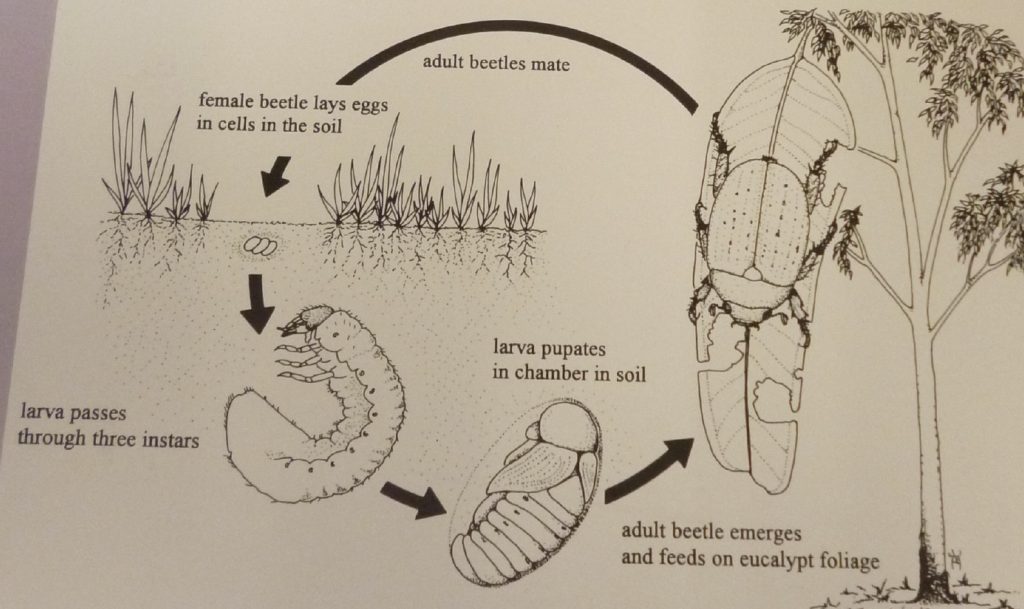
At their peak, Christmas beetles appear in astonishing numbers. Swarms can strip eucalypt trees of foliage, leaving them skeletonised. In rural landscapes during the 1970s and 80s, they were particularly abundant in improved pastures, where moist soils and a carpet of fine grass roots provided ideal conditions for their larvae.
After feasting on the eucalypts, they return to the pasture to lay their eggs in the soil.
Today, however, the story we tell ourselves is that Christmas beetles have declined. It certainly feels that way. Is it because urban sprawl has covered their larval habitat with concrete and asphalt? Have droughts hardened the soils they need? Do suburban gardeners favour lawns and exotics over gum trees, slowly pushing them out?
Are They Really in Decline?
In recent decades, there’s no doubt Australians have noticed far fewer beetles at Christmas. But there is no formal monitoring program, so there is no baseline to objectively measure population changes. Some ecologists and citizen scientists blame the usual culprit – climate change – as a possible cause for the decline of the Christmas Beetle. Others suggest their populations have declined due to urban expansion, habitat loss, and drought. It’s easy to assume this is another sign of biodiversity under pressure.
However, not everyone agrees. Forester and ecologist Vic Jurskis contends that the perception of decline might not reflect reality. He highlights that Christmas beetle numbers were artificially inflated during the peak years of rural tree dieback in the 1970s and 80s. During that period, pastures created ideal underground conditions for larvae, and dying eucalypts produced a seemingly endless supply of soft new leaves for adults to feed on. In other words, the so-called “golden age” of Christmas beetles could have been an ecological anomaly. This appears to be more of a boom period driven by stressed landscapes rather than a natural baseline.
As those old pasture trees finally died and as the landscapes moved away from that temporary state, beetle numbers returned to more “normal” levels. From this perspective, the recent lull might not be a catastrophic decline but rather the end of an irruption or a natural population boom and bust.
Boom, Bust, or Bust Forever?
There’s still some uncertainty. Some entomologists warn that urbanisation has definitely reduced beetle habitat. With fewer native trees in sprawling suburbs and more sealed surfaces over soil, their underground larval stage faces new challenges. Climate variability also influences this. Beetles do well in moist conditions, but extended droughts over the past twenty years probably suppressed their numbers.
Encouragingly, the story isn’t all doom and gloom. Reports from 2023 noted substantial numbers of Christmas beetles in parts of New South Wales and Queensland. This suggests that when conditions are right – enough rainfall, healthy soils, and suitable trees – populations can bounce back significantly.
Perhaps all of this is revealing that the natural world doesn’t follow the rhythm of our nostalgia.
Should We Be Worried?
So, should we be worried about their apparent disappearance during our summer nights? The real question might be whether our expectations are based on a brief, unusual period in ecological history. The “beetle bonanzas” of the 1970s and 80s could have influenced our memories, but they may not represent a long-term natural condition.
Still, Christmas beetles are an essential part of the ecosystem. Their larvae help aerate soils, and the adults play a role in nutrient cycling both in the soil and by defoliating stressed trees. The larvae feed on roots, dung, rotten wood and rotting vegetation. The adults of most species feed on eucalypt foliage. If their decline is truly a permanent trend, it could indicate ecological simplification in a changing landscape.
For now, it’s too soon to consider them lost. Insect populations often fluctuate dramatically in cycles that humans find hard to observe over short lifespans. What seems like absence might just be a pause in the natural pattern of emergence and retreat.
A Personal Loss
Yet, even if it’s only a brief lull in their numbers, I can’t help but feel a pang of loss. The absence of those awkward fliers makes the summer nights feel quieter, less vibrant. Their vanishing is linked to childhood memories of cricket in the backyard, the faint aroma of lawn clippings in the evening air, and the thrill of staying up late on hot nights when no one could sleep.
For me, at least, Christmas beetles aren’t just insects. They are part of the soundtrack and scenery of growing up in suburban Sydney. They connected us, however unconsciously, to the soil beneath the lawn, the gum trees in the park, and the wild cycles of life playing out all around us.
A Seasonal Hope
Maybe they will never reach the numbers of our childhood again. Perhaps those years were just a fluke, a once-in-a-lifetime burst that we’ve mistaken for the normal. Or maybe, given the right mix of rain, trees, and soil, they’ll come back in a shimmering swarm, thudding into our screens and walls, reminding us once more of what summer used to sound like.
So this Christmas, if you’re lucky enough to hear that familiar whirr-thud outside the back door, pause for a moment. Pick one up, admire its jewel-like sheen, and remember that you’re holding a noisy, bumbling, utterly Australian that heralds the holiday season.
Informative and nostalgic – great article
When I was a boy in Malanda before WW2, people relied on tank water. I recall one year when a number of people suffered gastric attacks, which were attributed to ‘beetleitis’ resulting from dead Christmas beetles being washed into the tank strainers, rotting there and polluting the water.
Preventative action was to boil the tank water before drinking or using it for cooking.
I well remember those beetles, very much part of the glow of Christmas!
Dear Robert, your article reminded me that I had not seen a Christmas beetle for many years.
Last Saturday night, we hosted a musical evening at our house on a warm, balmy night. To my surprise, an adult Christmas beetle joined in the fun.
Regards, Frank