
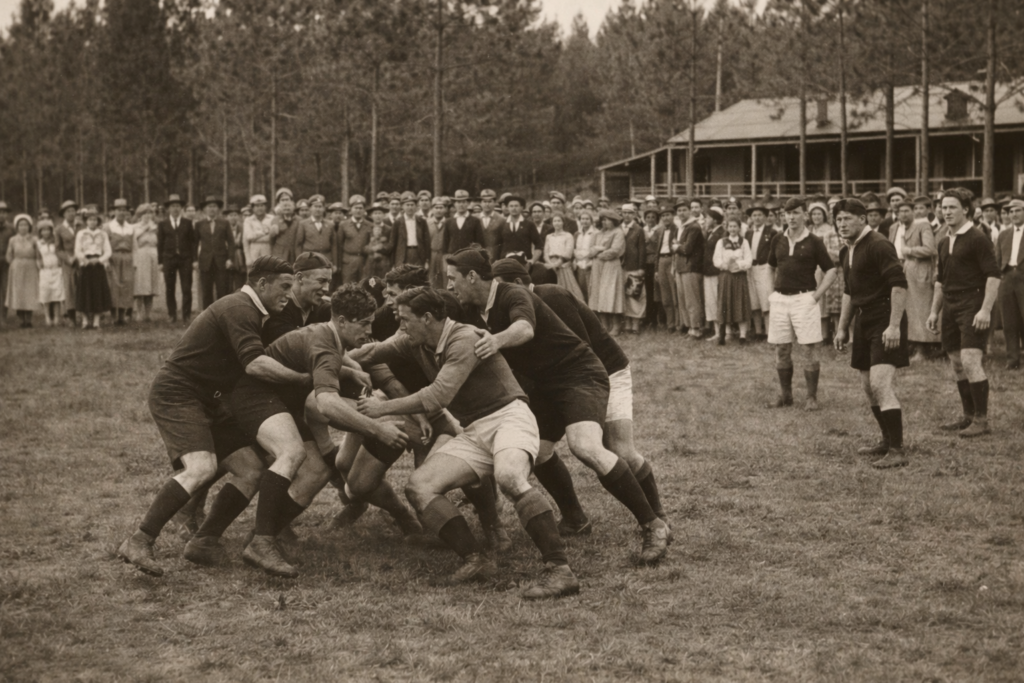
There is something quietly remarkable about the idea of organised football on Fraser Island.
Today, the island is framed as a World Heritage wilderness. But for much of its modern history, it was anything but quiet and free of human presence. It was a working landscape, alive with timber camps, tramlines, sawmills and small, tightly bound communities scattered across an otherwise inhospitable terrain. Men worked hard, lived simply and endured long stretches of isolation broken only by the arrival of a launch or the occasional trip to the mainland.
And remarkably, in that isolation, football flourished.
From mission grounds to the first representative match
The story begins earlier than one might expect.
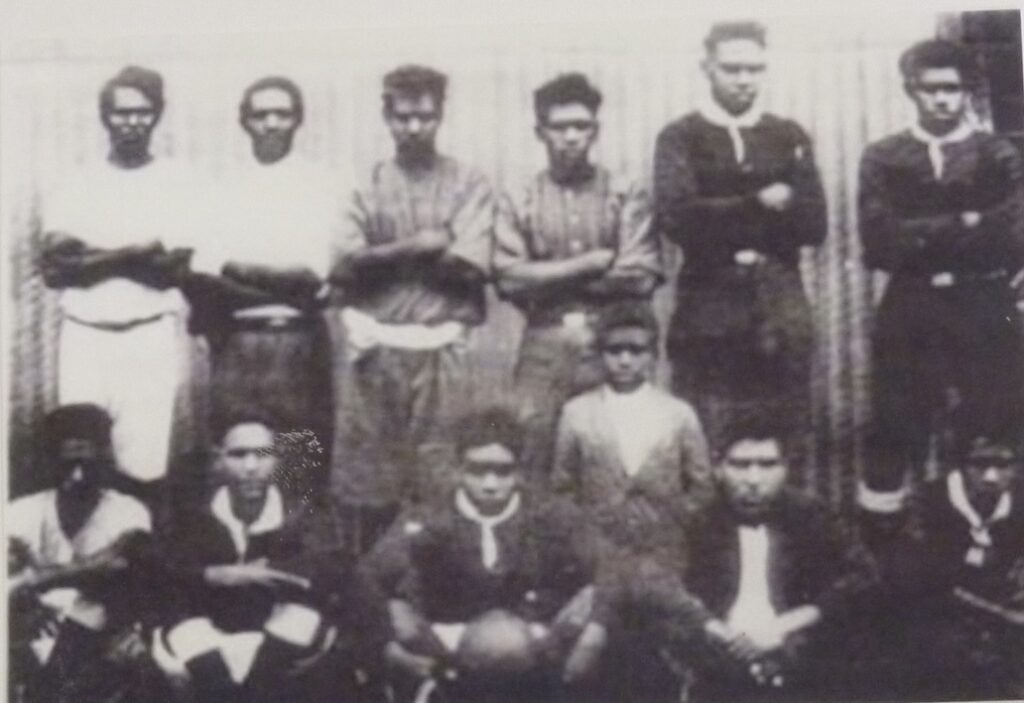
In August 1897, under the auspices of the Queensland Rugby Union, arrangements were made for a representative match between a Brisbane side and a Fraser Island Aboriginal team known as the “Mestonians,” named after Archibald Meston, the Protector of Aborigines responsible for establishing the island’s early Aboriginal settlement, which later became known as a Mission station.
This was rugby union — long before rugby league split from it — and it shows that organised football reached Fraser Island not through the timber industry, but through the Aboriginal mission.
Even at that early stage, football was a point of connection between isolated communities and the wider world.
The game takes hold
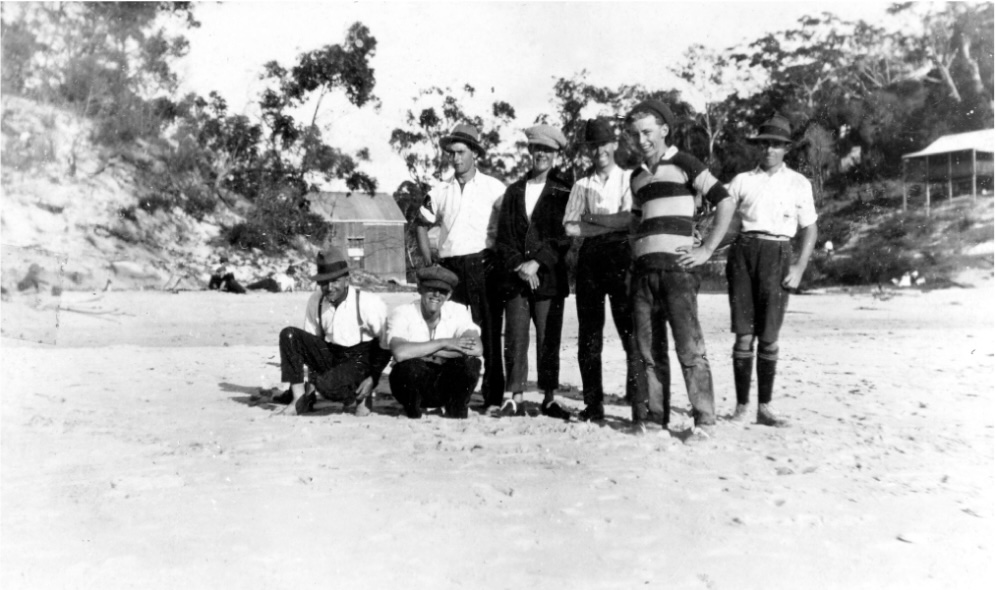
By 1920, the island had changed. Forestry camps had taken root at Woongoolbver Creek and North White Cliffs, centred around the McKenzie’s operation, and with them came a new kind of community of hard-working, self-contained and eager workers looking for recreation on their day off.
For months, according to one report, the forestry men had been:
Itching to show their prowess on the football field.
When the opportunity finally came, it was seized with enthusiasm.
Matches were arranged with Pialba on the mainland — at Point Vernon and Urangan — and the occasion extended well beyond the field, with euchre parties and dances rounding out the day. Football wasn’t seen just as a game. It was a full day and night event. And it quickly evolved into something more.
A three-team competition emerges
In that first season, three teams formed the nucleus of what can now be recognised as a genuine competition made up of Woongoolbver Creek (Forestry), McKenzie’s/North White Cliffs and Pialba All Blacks.
What followed was, in effect, an early version of a district competition, played across the bay and between camps, with matches held over successive weekends.
By season’s end, the premiership was decided at Pialba. Fraser Island, represented by McKenzie’s team, defeated Pialba convincingly, 21 points to 8, in what was described as a strenuous match. The result clearly stung the home crowd, with one report noting that the Pialba barrackers, “especially the ladies,” were left disappointed, though not without the sympathy of the Fraser Island “Tigers.”
It is a small but telling detail that not only were women present, but they were also emotionally invested in the outcome. This was no casual pastime. It was a competition, and it mattered to the locals.
A red letter day at Woongoolba
If the 1920 premiership confirmed the existence of competition, the 1921 season reveals just how deeply football had embedded itself into island life and how organised it had become.
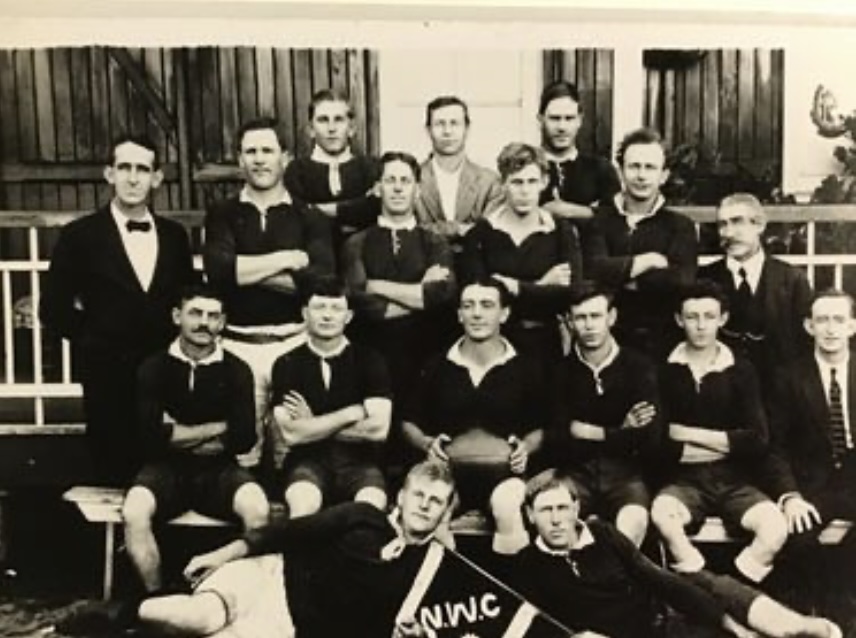
The Pialba District Association ran the competition and the Forestry Pastime Club had a functioning administration, with a president, secretary and treasurer supported by an active committee. There was intention, organisation and a desire not just to play, but to build something enduring. Football, it was said, would “boom like a dreadnought gun.”
On 24 April 1921, the Woongoolbver football ground was officially opened with a match between two fierce but friendly island rivals.
What followed was a full community occasion. The Forestry players, their supporters, wives and “wee ones,” gathered for what was described as a “monster al fresco picnic.” There was colour, laughter and anticipation. The Cliffs team’s arrival was met with hospitality, food, conversation and genuine goodwill.
Then came the match. Under the captaincy of Will Jarvis and Fred Stanford, and with Alf Burton controlling proceedings with what was noted as fairness and skill, the game unfolded as a tight, evenly contested struggle. The first half ended scoreless. The second half saw relentless pressure from both sides until, in a moment of individual brilliance, Wally Barton forced his way through the ruck to score the only try of the game.
The final score speaks to the defensive intensity of the contest. The Cliffs threw everything into the closing stages but could not break through. They were defeated, but not disgraced.
The detail in the newspaper report is remarkable, not just for the play, but for what surrounded it. Oranges at half-time, ladies organising the feast, children playing nearby and officials named and praised. This was football as a social institution.
The 1921 Premiership decider
Later that season, the premiership was decided at North White Cliffs. In difficult conditions, with a strong north wind blowing, the Cliffs side took on Forestry in a match that would determine the title. The Cliffs team had the tough and uncompromising Berthelson brothers, Albert and Tom, and fellow timber cutter August Wilchefski.
Forestry started strongly, but the Cliffs responded and, by half-time, led. In the second half, they dominated, moving the ball with confidence and control, ultimately winning 20-3.
The decisive victory crowned North White Cliffs as the premier. Between 1920 and 1921, the balance of power had shifted within the island itself.
Across the water again: the Kramer Cup
By 1936, the game had matured into a more formalised structure.
The Kramer Cup competition featured Torbanlea Miners, Pialba Aboriginals and the one Fraser Island team, the Timber Cutters. Rounds were played on Sundays with a running points table. At one stage, Torbanlea led with six points, Pialba had two, and Fraser Island had yet to score.
While the competition had continuity, structure, and meaning, it retained its character. This was no longer just a series of casual games. It was a competition and physicality was still evident. One match was marked by rough play, with a player from each side sent off. Football on Fraser Island was never timid.
More than a game
For all its competitiveness, football on Fraser Island never lost its social core. Matches were occasions, with crowds gathered from across the island. Visitors crossed the bay, food was shared and stories exchanged.
Sometimes the stories that emerged were as memorable as the matches themselves. One such story tells of Banjo Owens, an island player who, after being dumped in the saltpan at a match against Pialba on their homeground, took off at half-time at full pace to visit a lady friend, going in one window and coming out the other:
Pausing long enough to divest himself of excess energy.
He returned before the game ended, unnoticed by a referee who was liberally dosed with “medicine” from a cask provided by the visiting team.
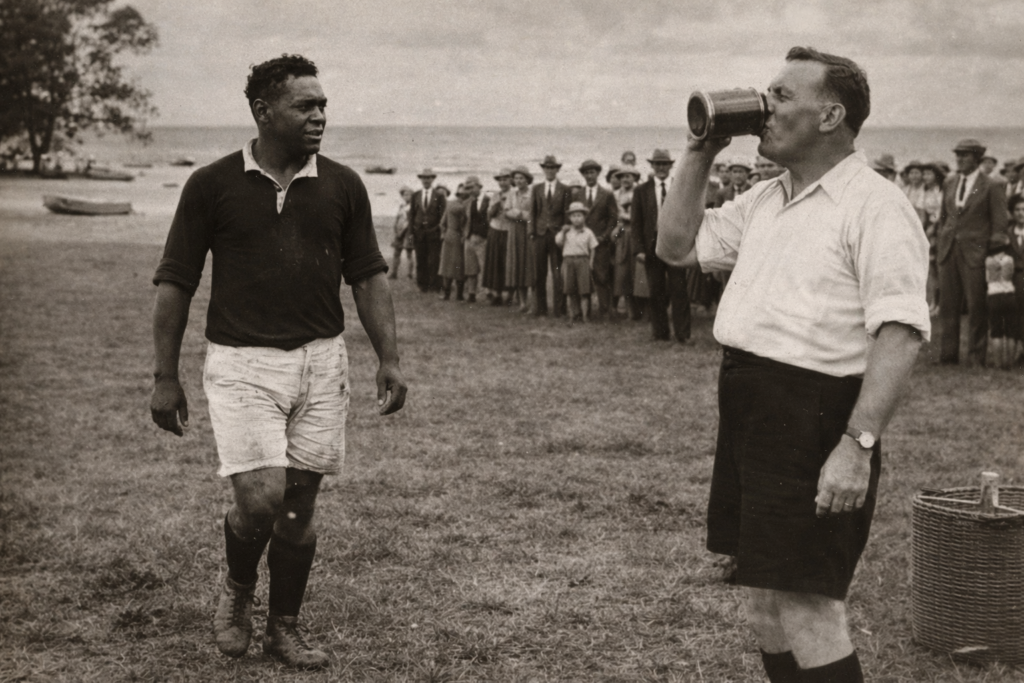
It is a story that captures something essential at the time. The looseness, the humour and the humanity of football played far from the constraints of formal competition. Football here was shaped by life, not governed by rigid discipline.
What emerged from the newspaper accounts is the nature of the Fraser Island football and its players. It was described as strenuous, willing and at times “unscientific”. These were not trained athletes, but timber workers, accustomed to physical labour and long days. Their fitness was earned, not coached, and they played accordingly.
The game fades away
By the early 1940s, the record falls silent. War, industry change, age and the gradual decline of the camp system eroded the conditions that had sustained the game. The teams disappeared and the competitions ceased. What remained was memory.
Today, there is nothing to mark those fields. No goalposts, stands, or trophies are on display. But the story survives in fragments of newspaper reports, recollections and glimpses of a time when Fraser Island was not just a place of natural beauty but also a place of human endeavour.
And in those fragments of history we know about, there is an enduring element. That even in isolation, people come together, compete and celebrate. And they find ways, however unlikely, to keep the game alive.
Another well-researched story on FI. Thanks for taking the time to research all this stuff. John
Great bit of social history Robert. Make sure Qld Rugby Union sees this.