
Introduction: why this story needed to be written
I have previously written about satinay. In an earlier essay, ‘The aristocratic satinay,’ I explored the history of this remarkable Fraser Island timber, from its initial neglect to its eventual recognition as one of Australia’s finest hardwoods. That story emerged from years spent in and around Fraser Island’s forests and from a fascination with how a timber once considered unworkable came to be highly valued for flooring, furniture and demanding marine applications.
I revisited satinay again in Chapter 11 of my book Paradise Preserved, where I explored in more depth how forestry research, improved seasoning techniques and technological advancements changed satinay’s reputation. In that chapter, I also acknowledged a claim that has almost become inseparable from satinay’s public story: that it was used to line the Suez Canal.
Back then, I approached that claim carefully. I noticed it kept appearing in popular stories and tourism brochures, but I couldn’t find a solid source explaining when, where, or how satinay was used in the canal. The more I saw the claim, the clearer it became that it was being repeated much more often than it was actually investigated.
This essay is the result of choosing to properly test that story.
My aim here is not to diminish satinay’s genuine achievements as a timber, nor to deny Australia’s involvement in major overseas engineering works. It is to take one specific claim — that Fraser Island satinay lined the Suez Canal — and subject it to the same standards of evidence and common sense that we would apply to any other historical assertion.
To achieve that, it first helps to understand what the Suez Canal was, why it took ten years to build, and how engineers tackled its most persistent issues. Only then does it make sense to consider where timber fits into that story, and where it didn’t.
Building the Suez Canal: ambition, politics and engineering reality
The idea of creating a waterway between the Mediterranean and the Red Sea had been around for centuries, but it was only in the mid-nineteenth century that it became both politically and technically feasible. Control of the route to India and the East had become crucial for imperial power, and European rivalries added urgency to the project. France saw a chance to reshape global trade. At the same time, Britain, whose lifeline to India went around the Cape of Good Hope, initially opposed the plan, fearing French influence over a strategic chokepoint.
The political contest was matched by practical difficulty. Construction began in 1859 under Ferdinand de Lesseps, but progress was slow. For much of the first decade, excavation relied heavily on forced Egyptian labour working with hand tools under harsh conditions. Mortality was high, machinery was limited and capital was constrained. The ten-year construction period reflects not inefficiency, but the realities of building a continent-spanning project with rudimentary means.
Importantly, the canal was designed as a sea-level cut, not a walled channel. It was dug through sand, salt flats and shallow lakes. The banks sloped gently and the channel was narrow, with passing bays at intervals to enable ships to pass. Since its opening in 1869, it has required ongoing dredging to stay navigable.
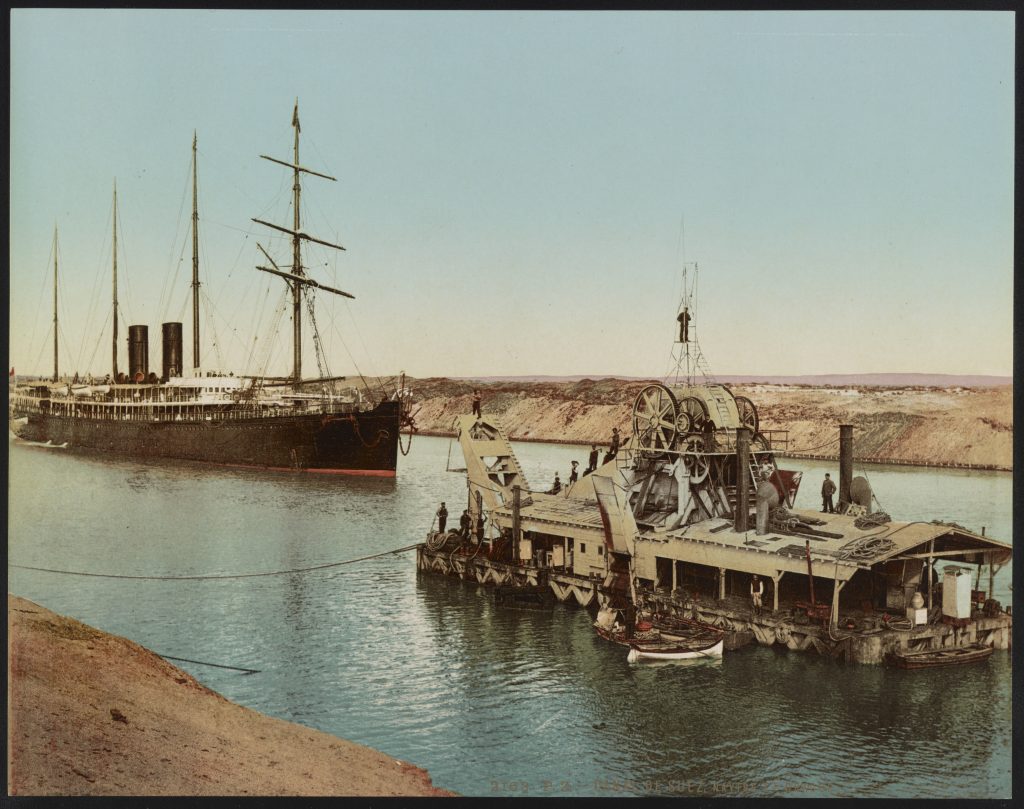
This fundamental fact dictates everything that follows. The Suez Canal was not a structure simply waiting to be clad or lined. It was an open, fluctuating earthwork, shaped and reshaped by dredging, currents and traffic. Any discussion of materials must begin with that reality.
As shipping grew and vessels became bigger and more powerful, new problems arose. Propeller wash and displacement waves eroded the banks, especially at passing bays and near ports. Engineers responded practically. They didn’t try to rebuild the canal completely. Instead, they reinforced certain vulnerable sections, widened key points, and improved dredging capacity.
It is in this context, decades after the canal’s opening, that timber becomes a significant part of the story.
Timber and the canal: limited use, specific purpose
Once the Suez Canal was in operation, its most persistent challenge was not construction but maintenance. The canal was an open, dredged channel cut through unstable material. Its banks were shaped by sand and spoil, not stone or masonry. As ship traffic increased, and as vessels became larger and more powerful, the canal’s edges came under increasing pressure from wash, currents and propeller action.
Engineers identified vulnerable sections — passing bays, port approaches, and stretches prone to erosion — and applied localised solutions. These included stone revetments, fascines, and, where conditions warranted, sheet piling.
Sheet piling was never a common feature of the canal. It was used selectively, where dredging alone couldn’t keep the banks stable. Australian newspaper reports from the 1880s show this understanding. They mention the possibility that canal authorities might use sheet piling in certain parts of the canal and suggest this as a potential market for long timber piles. The focus was always on specific sections, not the entire canal, and on piles rather than planking or lining.
Within this framework, one Australian timber stands out clearly in the historical record. By the late nineteenth century, jarrah had built a strong reputation for durability in wet and marine environments. It was widely exported and actively promoted for heavy structural use. In 1891, an Australian report stated that jarrah had been tested at three locations along the canal — Suez, Port Said and Ismailia — and that, after seven years, the timber was examined and found to be practically indestructible.
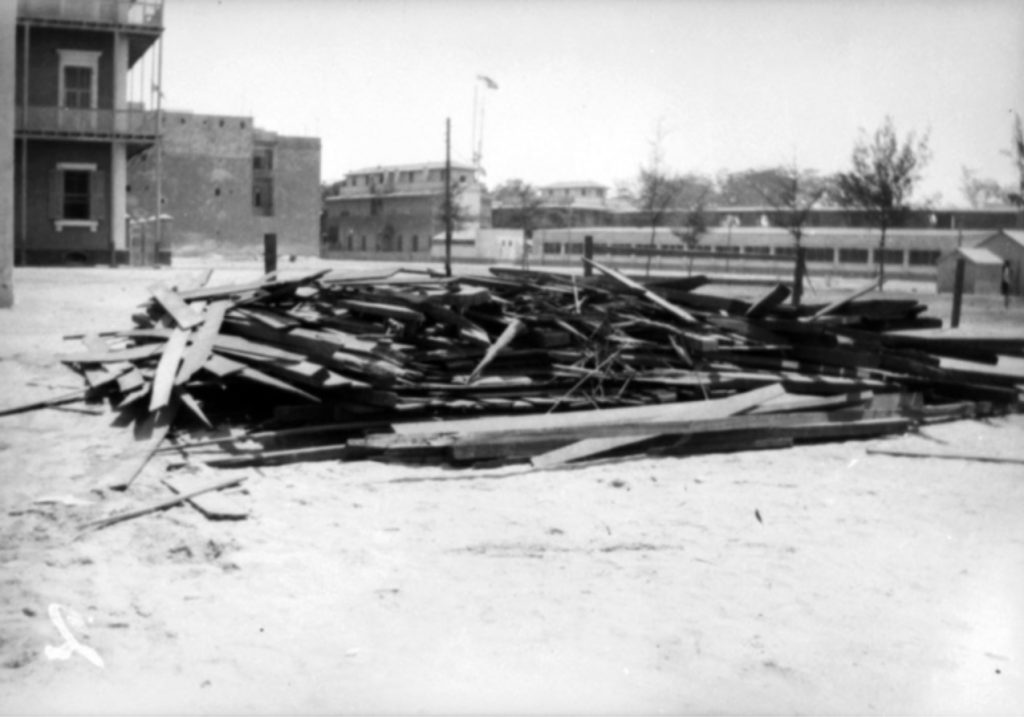
This reference is important because it aligns with both engineering logic and chronology. If canal engineers were testing materials for use in wet, saline conditions, jarrah was an obvious candidate. Its appearance in the canal record is specific, plausible and supported by contemporary reporting.
What matters just as much is what does not appear alongside jarrah in this period. There is no comparable reference to satinay in nineteenth-century discussions of the canal. No trials. No shipping notices tied to canal works. No engineering commentary. No forestry literature linking satinay to canal construction or early maintenance.
This absence is telling. If Fraser Island satinay had played a significant role in the canal’s early history, one would expect to find it in the same kinds of sources that mention jarrah. Instead, it is absent from the record at precisely the time when such references would be expected.
To understand why, it is necessary to step away from the canal and look closely at satinay’s own history.
Satinay’s real history: from overlooked timber to global reputation
When hardwood logging began on Fraser Island, satinay was not regarded as a valuable species. As forester E.F.H. Swain later observed, the timber had a very high moisture content when felled and shrank significantly during drying. Early sawmillers discovered that boards warped and twisted. Compared to other hardwoods that seasoned more easily, satinay was considered troublesome and unreliable.
This perception had significant consequences. About 80 per cent of the hardwood volume on Fraser Island was in satinay–brush box forests. Because these species were viewed as unmerchantable, they were often seen as an obstacle to logging rather than a resource. In many areas, large and impressive trees were ringbarked to clear the overstorey. Silviculturally, it allowed foresters to ensure regeneration in patches where logging occurred around the satinay trees.
The situation only changed when the forestry administration itself shifted. Under Swain’s leadership as Director of Forests, a deliberate effort was made to understand the properties of Queensland timbers instead of dismissing them. Swain launched a comprehensive timber research program and established Australia’s first Forest Products Laboratory. After visiting Fraser Island in 1922, he expressed frustration at the “millions of super feet” of satinay and brush box that remained unused. He believed that if a market could be found, satinay could become a valuable and affordable hardwood.
In 1923, Forestry established a Timber Investigations Branch to study the properties and potential uses of Queensland timbers, including satinay. The findings challenged earlier beliefs. When satinay was sawn into boards and dried carefully under cover, it was found to season well. The introduction of kiln-drying technology further enhanced results, allowing moisture levels to be controlled and defects reduced.
At the same time, satinay’s identity was intentionally reshaped. The timber was renamed from Fraser Island turpentine to satinay, dropping its earlier reputation as unworkable. This was more than just a name change. It signified a shift in how the timber was marketed and understood by users.
Public exhibitions played a vital role in this change. In July 1924, Forestry displayed a satinay duchess chest at the Brisbane Showgrounds. Its fine figuring, often compared to maple, drew attention and helped establish satinay as a high quality furniture timber. In 1929, a Forestry exhibit at the Brisbane Show featured a mock-up of Fraser Island’s Valley of the Giants built on satinay flooring, guiding visitors through displays of satinay furniture and joinery.
Alongside its aesthetic appeal, the understanding of satinay’s durability improved. Swain noted that three logs in Yankee Jack Creek, submerged by the tide twice daily for fifteen years, stayed sound and solid, having only lost their sapwood. Another tree, felled, cut into logs and left in the bush for forty years, milled as easily and looked as fresh as freshly felled timber.
These observations highlighted satinay’s exceptional resistance to decay and marine borers. The first documented cutting of satinay for piles took place in 1918, when trees were felled to construct McKenzie’s jetty on the island at North White Cliffs. The first verified commercial sale occurred in 1924, when logging contractors Wilschefski Brothers and Albert Berthelsen harvested 51 exceptionally sound, flawless 60-foot logs near Yankee Jack Creek. These were sent to the Rockhampton Harbour Board for use at Port Alma.
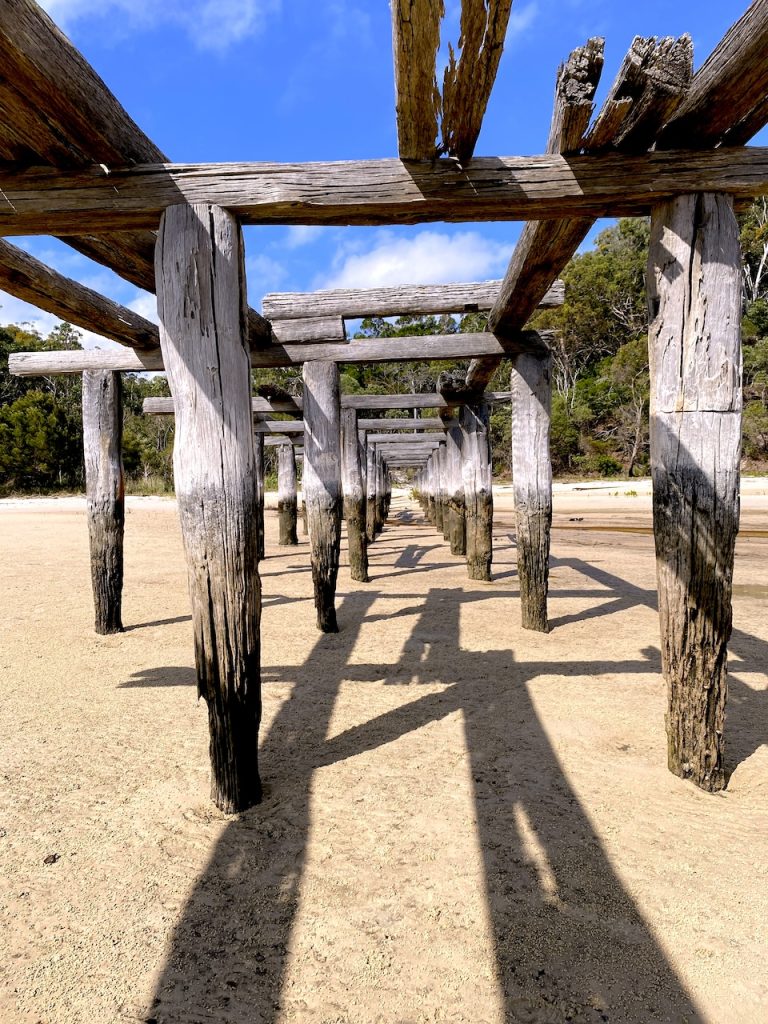
By 1926, satinay piles were being used in the construction of the Granville Bridge in Maryborough. McKenzie & Company’s annual report confirmed satinay’s successful introduction as a preferred sawn timber and its growing acceptance in southern markets.
Satinay eventually entered the international documentary record much later, and in a very different context. In 1931, newspapers reported that Forestry had prepared 167 satinay piles on Fraser Island, each seventy feet long, for export. Later reporting made it clear that these piles were destined for London, where they were to be used in the construction of Empire Wharf at Falmouth Docks.
The brief mention of “Suez” in the original notice referred to the shipping route, not the destination. At the time, it was common to describe cargo movements by listing major ports of call. There is no evidence that these piles were intended for use in the Suez Canal, nor that they were used there.
This point is important because the 1931 shipment is often misunderstood or misrepresented. When read correctly, it does not support the canal story. Instead, it shows that by the early 1930s, Fraser Island satinay had proven itself suitable for large marine works and was being exported for that purpose. That is a significant achievement in its own right. It does not need to be tied to the Suez Canal to be impressive.
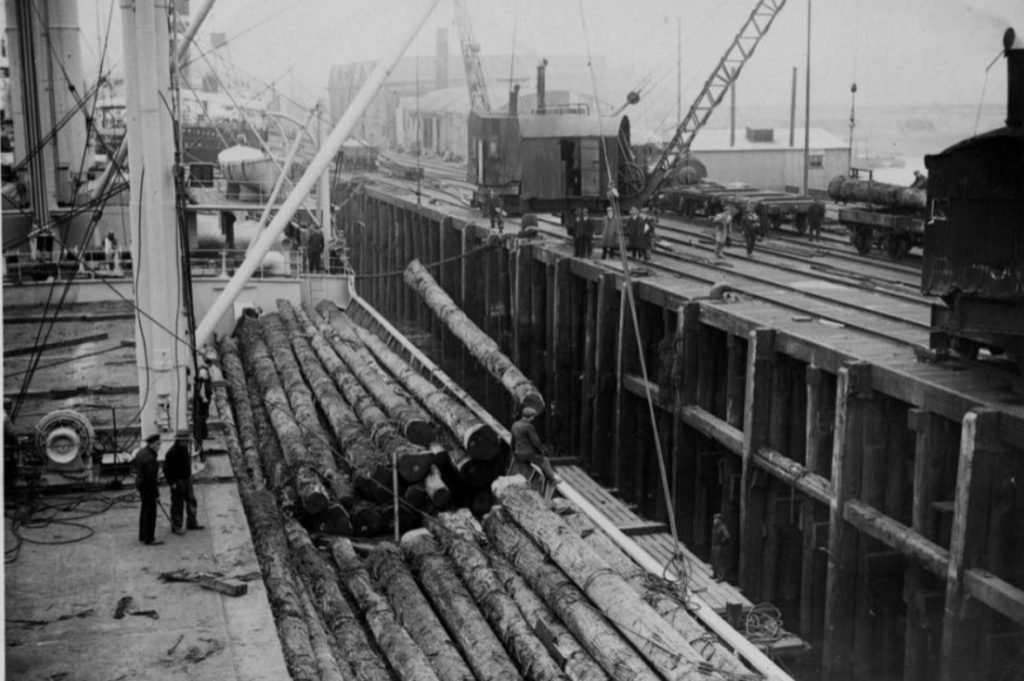
This is the documented history of satinay’s rise. It is a twentieth-century story, driven by research, improved seasoning methods and changing technology. It explains why satinay eventually gained a worldwide reputation as a marine pile. It also explains why satinay does not appear in nineteenth-century canal records because its value had not yet been recognised.
Repetition without evidence: how the tourism myth took hold
It is at this stage that the tourism stereotype must be challenged directly. The supposed connection between satinay and the Suez Canal seems to rest on an unreferenced claim that has been repeated so often and for so long that its origin has become unclear and its accuracy seldom questioned.
The claim depends on three assumptions. The first is that the canal was lined the way the story suggests. It was not. The canal was an open, dredged channel maintained through dredging and local reinforcement, not by continuous walls. There was nothing to line.
The second assumption is that satinay was already recognised and used as a marine timber in the 1860s. It was not. As the forestry record shows, satinay’s qualities were not adequately understood or exploited until decades later. Also, the first logging on the island targeted only softwoods that could float, as they were tied into rafts and punted across the Great Sandy Strait and up the Mary River to the sawmills. Hardwood logging didn’t start until the late 1870s.
The third assumption is that references to Fraser Island timber and “Suez” must refer to the canal itself. In practice, “Suez” often appears as a shipping route or port of call rather than as an end use. This distinction has been blurred through repetition.
Once these assumptions are scrutinised, the claim falls apart. What remains is not a forgotten chapter of engineering history, but a contemporary embellishment based on repetition rather than documentation.
Anecdotal recollections, including claims by soldiers who believed they recognised satinay in mooring posts along the canal, cannot replace concrete evidence. Identifying weathered hardwoods in their original setting is challenging even for trained foresters, and such observations, even if genuine, do not prove provenance or usage.
What the record shows is consistent and clear. Timber was used in and around the canal where engineering conditions called for it. Jarrah appears in nineteenth-century trials because it had already gained a marine reputation. Satinay appeared later, but in places other than the Suez Canal, because it required time, research and technological changes to unlock its potential.
If evidence exists that shows Fraser Island satinay was used in works associated with the Suez Canal itself — supported by primary sources such as engineering specifications, procurement records, shipping manifests tied directly to canal contracts, or contemporaneous reports from the canal authority — then it deserves to be examined. Claims of this scale should rest on documents, not repetition. Until such material is produced, the story that satinay lined the Suez Canal remains unsupported by the historical and engineering record. Those who can add to that record with verifiable evidence are invited to do so.
Thank you, Robert. Another myth busted!
As one who was told and accepted the story about the satinay and Suez Canal when I came to Qld in 1978, I confess to my part in furthering the myth as part of my interpretive work for national parks. Oops!
I have often wondered, when viewing videos of vessels using the canal over the years, why I did not see the rows of stately logs I expected to see.
Cheers
Ron Turner
Nicely unpicked, Robert.
Makes you wonder how many other “facts” we see are just the product of unquestioned and continuous repetition of an original misunderstanding or error.
Thank you for the in depth look into the Satinay story.
I, too, perpetuated the myth, even though I had some misgivings of my own about dates that did not align, some with the first harvests of the Satinay and others with the construction and ongoing maintenance of the Suez Canal.
My initial understanding of the satinay being used in the Suez Canal came from the writings of Fred Williams and also John Sinclair, neither of them providing references to source material on the subject, and both providing different times as to when satinay began to be logged from the Island for maritime use.
A copy of your book finally arrived in the mail this week, and I am looking forward to reading it!
Thanks, Robert. A good one.
It would be interesting to know when the myth started. When I was training on Fraser Island in 1968 and first encountered satinay, only the London wharves were mentioned. No stories about the Suez Canal.